
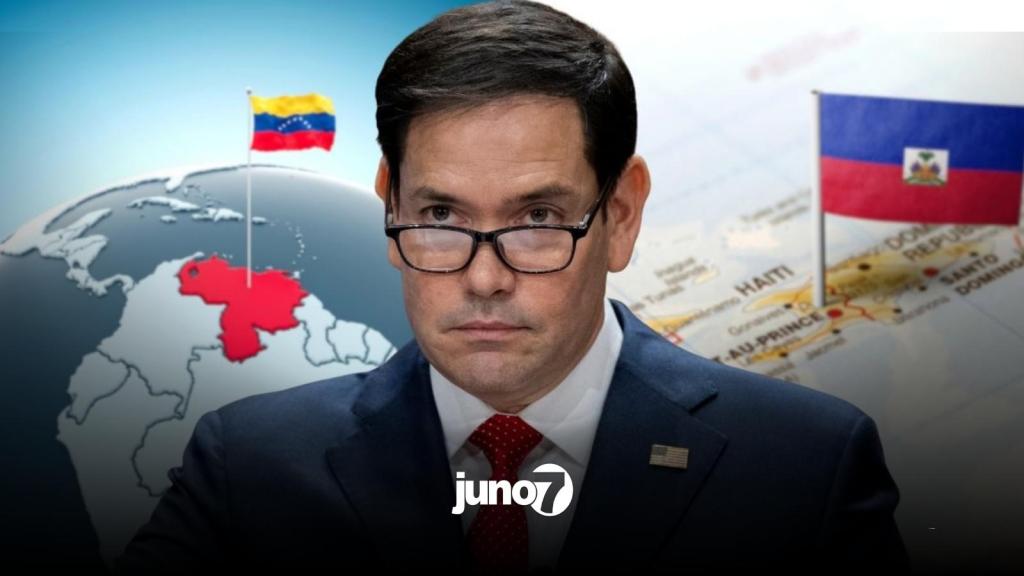

A central figure in U.S. diplomacy in Latin America, Secretary of State Marco Rubio has established himself as the architect of a deliberate interventionnisme in Venezuela — justified in the name of the fight against “narco-terrorism,” energy security, and the Iran–Hezbollah axis. Yet this firmness contrasts sharply with Washington’s ongoing inaction toward the gangs ravaging Haiti, which are largely armed from the United States (1)(2).A portrait by Nancy Roc, exploring both the making of a hawk and the heavy consequences of a geopolitical double standard.
Marco Rubio: A Hawk Forged in Miami
Marco Rubio is the political product of a Florida where anti-communism, Cuban exile networks, and U.S. foreign policy are intimately intertwined (3). In this pivotal state, toughness toward leftist regimes in Latin America has long been a key electoral asset. Rubio built his career within this ideological framework, turning foreign policy into a direct extension of domestic battles.
But his relationship to drug trafficking and transnational crime is not merely ideological. A detailed investigation published by The American Prospect revealed that as a teenager, Rubio worked for his brother-in-law’s exotic animal import company, which served as a front for massive cocaine and marijuana smuggling (4). The report mentioned shipments of hundreds of thousands of pounds of drugs — a chapter absent from official biographies and rarely mentioned in mainstream profiles of the future Secretary of State.
This documented yet politically buried past casts new light on Rubio’s current rhetoric. Having risen from senator to America’s top diplomat, he has fused counter-narcotics, counterterrorism, and geopolitical rivalry into a single security doctrine (5). The concept of “narco-terrorism” allows him to criminalize entire states, relativize national sovereignty, and justify sanctions, covert operations, and even the direct use of force.
Venezuela: Oil, Iran, Hezbollah… and China in the Background
The operation leading to the fall of Nicolás Maduro marked the culmination of Rubio’s doctrine. Officially presented as a counter-narcotics action (6), it in fact pursued much broader strategic goals. Venezuela holds the world’s largest proven oil reserves (7) — a central fact amid global energy tensions and shifting alliances.
Under Rubio’s influence, U.S. policy toward Venezuela evolved into a global strategic vision aimed at containing the growing influence of rival powers in the Western Hemisphere (8). For Rubio, Venezuela could not be allowed to become an “operational base” for actors deemed hostile to U.S. interests — foremost among them Iran, Russia, China, and non-state networks such as Hezbollah (9).
Over the years, Caracas and Tehran have strengthened their ties through energy agreements, logistical cooperation, technological exchanges, and mutual political support (10). To Washington, this relationship made Venezuela a regional anchor of Iranian influence in the Americas. Added to this were concerns about Hezbollah-linked financial and logistical networks in Latin America, documented by the U.S. Treasury and congressional committees (11).
Yet behind this security rhetoric lies a quieter but more structural concern: China’s expanding footprint. Beijing has deepened its relationship with Caracas through oil-backed loans, energy investments, infrastructure projects, and steady diplomatic support (12)(13). For Washington, this Chinese presence, combined with Russian and Iranian influence, has entrenched a geopolitical counterweight within what the United States has long regarded as its privileged sphere of influence (14).
In Rubio’s framework, Venezuela thus became a strategic crossroads, blending energy, narcotics, terrorism, and great-power competition. In his eyes, this configuration justified a bold legal and diplomatic gamble: Venezuela’s sovereignty could be suspended in the name of U.S. national security, now redefined on a continental scale.
Haiti: Washington’s Strategic Blind Spot
By contrast, Haiti remains relegated to the status of a peripheral crisis. Yet the violence tearing the country apart is neither spontaneous nor isolated. According to the United Nations, most of the weapons used by Haitian gangs originate from the U.S. market — primarily from Florida (15). These weapons move through well-known channels, enabled by lax controls and weak prosecutions (16).
Despite this documented responsibility, Washington continues to manage Haiti’s chaos from a distance: verbal support for international missions, sporadic humanitarian aid, but no serious coercive strategy against arms networks or financial circuits. Haiti is treated as a chronic humanitarian crisis, not as a strategic issue.
What International Law Says
From an international law perspective, America’s strategy in Venezuela and its prolonged inaction in Haiti raise fundamental questions. The U.N. Charter enshrines the principle of state sovereignty and prohibits the use of force without explicit Security Council authorization or an act of self-defense(17).
In Venezuela’s case, Washington sought to circumvent this framework by framing its intervention as an enforcement measure against “narco-terrorism” (18). Yet the notion of narco-terrorism has no autonomous legal status under international law that would allow suspension of a state’s sovereignty (19).
Conversely, Haiti exemplifies another side of international law: the duty not to worsen a crisis. The Arms Trade Treaty imposes on exporting states a duty of vigilance when there is a risk that weapons may be used in serious human rights violations (20). U.N. reports establishing the American origin of many weapons used by Haitian gangs therefore raise an issue of indirect responsibility (21).
Finally, the Responsibility to Protect (R2P) principle, adopted in 2005, exposes the selectivity of the global order: invoked where strategic interests are at stake, it disappears where there is only poverty and disorder (22).
A Morality of Double Standards
The contrast between Venezuela and Haiti reveals a brutal constant: U.S. interventionism is never driven by human suffering but by strategic value (23). Where oil, geopolitics, and defined enemies converge, force is deployed. Where there are neither critical resources nor adversaries, inaction becomes doctrine.
Haiti possesses no oil, no strategic minerals, no pivotal energy role (24). Its security collapse does not directly threaten U.S. economic interests. Thus, its implosion becomes an acceptable political cost — as long as its chaos remains contained within its borders.
Conclusion — The Human Cost of Indifference
Marco Rubio’s doctrine exposes a disturbing truth: chaos is tolerated when it threatens no major strategic interest. Yet this external reality cannot absolve Haitian leaders themselves. Endemic corruption, administrative incompetence, and a lack of strategic vision have hollowed out the state.
Donald Trump’s words — as brutal and controversial as they may be — echo certain analyses when he describes fragile states as ruled by corrupt and inept elites (25). This rhetoric, however, is dangerous: it paves the way for the normalization of disengagement and for privatized security solutions, in line with mercenary Erik Prince’s proposals (26).
In Haiti, the dead number in the thousands, the displaced in the hundreds of thousands, and hunger gnaws at an entire nation abandoned to gangs. This collapse is neither unforeseeable nor accidental. It is the product of a double abandonment: that of an international community guided by strategic interest, and that of local elites corrupted and incapable of governance.
Unlike Venezuela, Haiti threatens no oil barrel, no energy market, no global power balance. And it is precisely for that reason that its downfall is tolerated. Haiti’s chaos disrupts neither markets nor powers — thus it becomes acceptable.
An international order capable of toppling a regime for its interests but incapable of saving a people with no exploitable resources reveals its starkest truth: not all lives weigh the same.
Nancy Roc — January 6th, 2026
Read also: Roc and Truths – In-depth geopolitical analysis on Haiti and international power dynamics.
FOOTNOTES
- UNODC, Firearms Trafficking and Gang Violence in Haiti, 2024.
- GAO, U.S. Arms Export Controls and the Caribbean, 2023.
- Politico, Marco Rubio and Florida’s Foreign Policy Politics, 2022.
- The American Prospect, “The Narco-Terrorist Elite…”, December 23, 2025.
- Congressional Research Service, U.S. Counternarcotics Policy in Latin America, 2024.
- AP News, January 2026.
- U.S. Energy Information Administration, Venezuela Country Analysis.
- Politico, Rubio’s Hardline Vision for Latin America, 2024–2025.
- U.S. Senate Hearings, 2024–2026.
- Reuters, Iran–Venezuela Strategic Cooperation, 2024–2026.
- U.S. Treasury Department, Hezbollah Financing in Latin America, 2023.
- Council on Foreign Relations, China’s Expanding Role in Venezuela, 2023–2024.
- Reuters, China Deepens Oil-Backed Ties with Venezuela, 2022–2024.
- Congressional Research Service, Great Power Competition in Latin America, 2024.
- U.N. Panel of Experts on Haiti, 2024.
- GAO, Weak Oversight of Small Arms Exports, 2023.
- United Nations Charter, Article 2(4).
- U.S. Department of State Statements, 2025–2026.
- Oppenheim’s International Law.
- United Nations Arms Trade Treaty (ATT).
- United Nations Reports on Haiti, various years.
- U.N., World Summit Outcome, 2005.
- Foreign Affairs, Selective Intervention and U.S. Power, 2023.
- World Bank, Haiti Country Economic Memorandum, 2022–2024.
- Politico / The Atlantic, analyses of Trump, 2018–2025.
- The New York Times; The Intercept, investigations on Erik Prince, 2020–2024.
Related News
Haïti – Taux de référence BRH: samedi 10 janvier 2026
Haïti – Taux de référence BRH: vendredi 9 janvier 2026

Élections en Haïti : la sécurité et les moyens financiers au cœur des exigences du CE...