

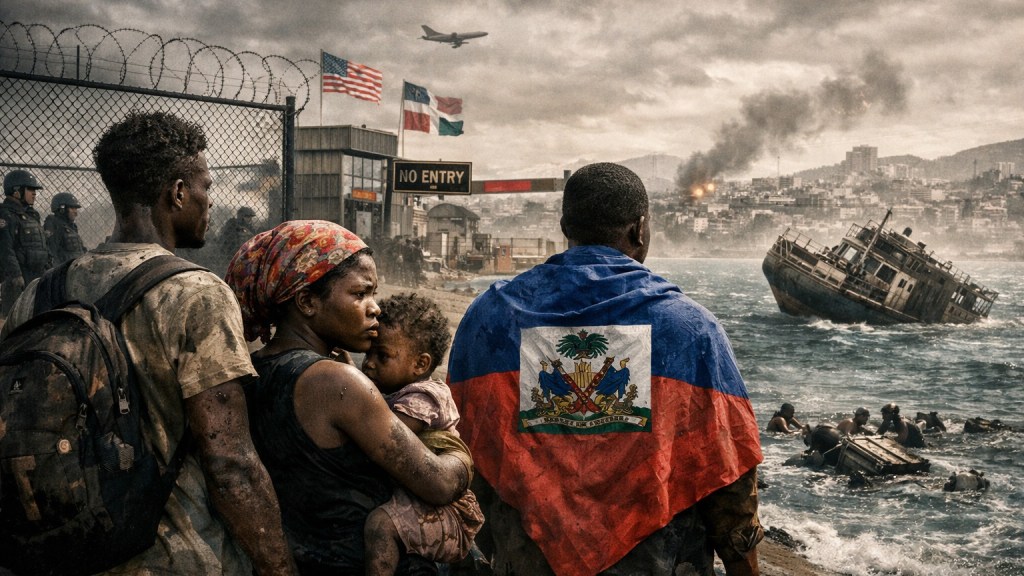

Since the early 2020s—and even more so since Donald Trump’s return to the White House—Haitians have faced near-universal rejection: suspended visas, accelerated deportations, closed borders, and regional agreements that explicitly exclude them. From the United States to the Caribbean and across Latin America, exile has become an obstacle course and asylum an empty promise.
Racism plays a role, of course. But it does not explain everything. The rejection of Haitians is also the product of geopolitical calculations, security obsessions, restrictive legal frameworks, and an openly acknowledged humanitarian fatigue. More troubling still: Haiti’s misery is no longer enough to elicit either protection or political compassion. An analysis by Nancy Roc.
From Compassion to Closure: The End of the Haitian Exception
After the 2010 earthquake, Haiti triggered an unprecedented global outpouring of solidarity. Promises of reconstruction, billions of dollars in aid, and the massive presence of NGOs and international missions followed. For a few years, the dominant narrative portrayed a people struck by an exceptional catastrophe, deserving of assistance and protection. Fifteen years later, that narrative has collapsed, replaced by that of a country mired in a structural crisis with no clear political horizon.
Crises have followed one another without relief: chronic institutional instability, corruption scandals, the collapse of public authority, the assassination of President Jovenel Moïse in 2021, followed by an explosion of gang violence and economic paralysis. Today, more than 80% of Port-au-Prince is under the control of armed groups according to the United Nations [1], and nearly 600,000 people are internally displaced [2]. Haiti is no longer seen as a country struck by a one-off tragedy, but as a state that is durably dysfunctional and incapable of ensuring the safety of its population.
In a world saturated with crises—Ukraine, Gaza, Sudan, Venezuela, Afghanistan—Haiti is no longer a priority. Compassion has given way to a logic of triage, and the Haitian crisis, lacking any credible political outlet, is gradually slipping out of the sphere of active international solidarity.
United States: Firmness as Political Doctrine
Donald Trump’s second term marks an even more brutal turning point in U.S. migration policy toward Haiti. As early as January 2026, the administration announced the suspension of visa issuance to Haitian nationals, while seasonal work programs were frozen and Temporary Protected Status (TPS)—which had allowed tens of thousands of Haitians to reside legally in the United States—was threatened with permanent termination [3]. These decisions are part of an explicit deterrence strategy aimed at drastically reducing migration flows from countries deemed unstable.
At the same time, immigration enforcement intensified: more than 17,000 arrests were recorded in a single month—the highest level in over a decade—with an openly stated goal of one million deportations in the first year of the mandate [4]. Haitians are not the only targets, but they are among the nationalities most affected by expedited removals, often without effective access to a full asylum procedure or adequate legal assistance.
Legally, however, Haiti’s situation does not automatically guarantee international protection. Asylum law protects against targeted persecution, not against poverty or generalized violence perpetrated by non-state criminal actors. Gangs—despite controlling large portions of the territory—are not recognized as persecuting authorities under international law. As a result, the majority of Haitian asylum claims are rejected for lack of legal grounds [5]. Thus, even as the country burns, the administrative machinery continues to operate as if catastrophe were merely background noise.
The Caribbean: Saturated Neighbors, Stalled Solidarity
In the Caribbean, the situation is even more paradoxical. Countries in the region are historically linked to Haiti through culture, human exchanges, and economic migration. Yet today they rank among the most restrictive in migration control, often in the name of internal stability and the strain on already fragile infrastructure.
The Dominican Republic, the main destination for Haitian migrants, has suspended the issuance of new visas, reinforced border militarization, and multiplied deportations. In 2024 alone, more than 250,000 Haitians were forcibly returned, often without any effective right to appeal [6]. Official discourse cites the overload of hospitals, schools, and social services, as well as the need to protect national security. In public space, however, rhetoric has hardened, and xenophobia is increasingly expressed openly, fueled by fears that Haiti’s crisis will spill across the border.
Even more revealing, some small island states have agreed to accept migrants turned back by the United States—on the explicit condition that they are not Haitian. Saint Kitts and Nevis has stated this without ambiguity, citing security reasons for excluding Haitian nationals from any relocation agreement [7]. In the Bahamas, home to a large undocumented Haitian community, fear of raids has become permanent. After Hurricane Dorian, many displaced Haitians did not even dare to seek shelter, fearing identification and subsequent deportation [8]. Regional solidarity exists in diplomatic speeches, but vanishes when it comes to concrete migration policies.
Latin America: From Welcome to Lockdown
After the 2010 earthquake, several Latin American countries—particularly Brazil, Chile, and Peru—opened their doors to Haitian migrants, allowing them legal access to the labor market and integration into sectors facing labor shortages. Tens of thousands of Haitians were thus able to settle, sometimes permanently.
That phase of openness is now over. Since 2018, Chile has imposed a restrictive special visa exclusively for Haitians, valid for only thirty days and non-convertible into a residence permit—a measure that drastically reduced legal entries [9]. Other countries have introduced transit requirements, hard-to-obtain consular visas, and reinforced border controls, making regular migration virtually impossible.
The direct consequence is that many Haitians are stranded in transit countries without legal status, vulnerable to smuggling networks, economic exploitation, and violence. The northbound migration route—particularly through the Darién Gap—has become both a survival corridor and a lawless zone marked by assaults, sexual violence, and extortion, with no guarantee of asylum upon arrival at North American borders [10].
Why Is Misery No Longer Enough
This is perhaps the most painful question: why does a country as devastated as Haiti no longer secure meaningful international protection for its citizens? First, because legally, misery has never been an asylum criterion. International law protects against targeted political, religious, ethnic, or social persecution—not against poverty, famine, or even generalized violence when it is not exercised by the state or against identifiable groups [11]. In Haiti, violence today is diffuse, criminal, fragmented, carried out by lawless gangs, and affects all social categories indiscriminately—rendering most protection claims legally ineffective.
To this legal barrier is added a major political fear: recognizing collective protection for Haitians would set a precedent likely to open the door to hundreds of thousands—if not millions—of claims, in a world already saturated with migration crises, a scenario no government is willing to defend before its electorate [12]. Between restrictive legal norms and timid electoral calculations, Haitian distress thus hits an administrative and political wall that turns misery into a dead end rather than a call for solidarity.
Conclusion
Haitians are not rejected simply because they are Black or poor—the case of Sudan proves that. They are rejected above all because they come from a state now perceived as durably unstable, politically irrecoverable, and incapable of protecting its citizens.
In this geopolitical grammar, misery no longer argues for asylum; it disqualifies. Borders do not close out of sheer cruelty, but out of fatigue, electoral calculation, security obsession, and strategic disengagement—while Haitian leaders continue to project the image of an absent or captured state.
Caught between a country that no longer protects and countries that refuse to import its chaos, Haitians wander in a moral no man’s land where exile is no longer a refuge but a succession of rejections. As long as Haiti remains without credible institutions or public security, its children will keep knocking on doors that close—not because they do not deserve to be saved, but because no one believes anymore that their salvation can come from outside.
Nancy Roc, January 15th, 2026.
Footnotes
- United Nations, BINUH, Report on the Security Situation in Haiti, 2025.
- OCHA, Haiti: Internally Displaced Persons, Humanitarian Bulletin, 2025.
- RFI, End of U.S. Visas for Haitians, January 2026.
- ICE, Enforcement and Removal Operations Statistics, February 2026.
- USCIS, Asylum Statistics Report, 2024.
- Dirección General de Migración (Dominican Republic), Annual Report 2024.
- Miami Herald, Caribbean Migration Deal Excludes Haitians, January 2026.
- The New Humanitarian, Bahamas: Haitians Fear Deportation After Dorian, 2020.
- Chilean Ministry of the Interior, Migration Policy and Humanitarian Visas, 2018–2024.
- IOM, Migration Through the Darién Gap, Monitoring Report, 2024.
- 1951 Geneva Convention Relating to the Status of Refugees.
- Council on Foreign Relations, Caribbean Migration and Security Risks, 2023.
- World Bank, Haiti Country Economic Memorandum, 2024.
Related News
Médiation politique : Mgr Pierre-André Dumas se retire du processus

Double assassinat à Delmas 40A : un policier suspecté par la PNH

Delmas 95 : un policier se rend après la mort par balle d’une adolescente