

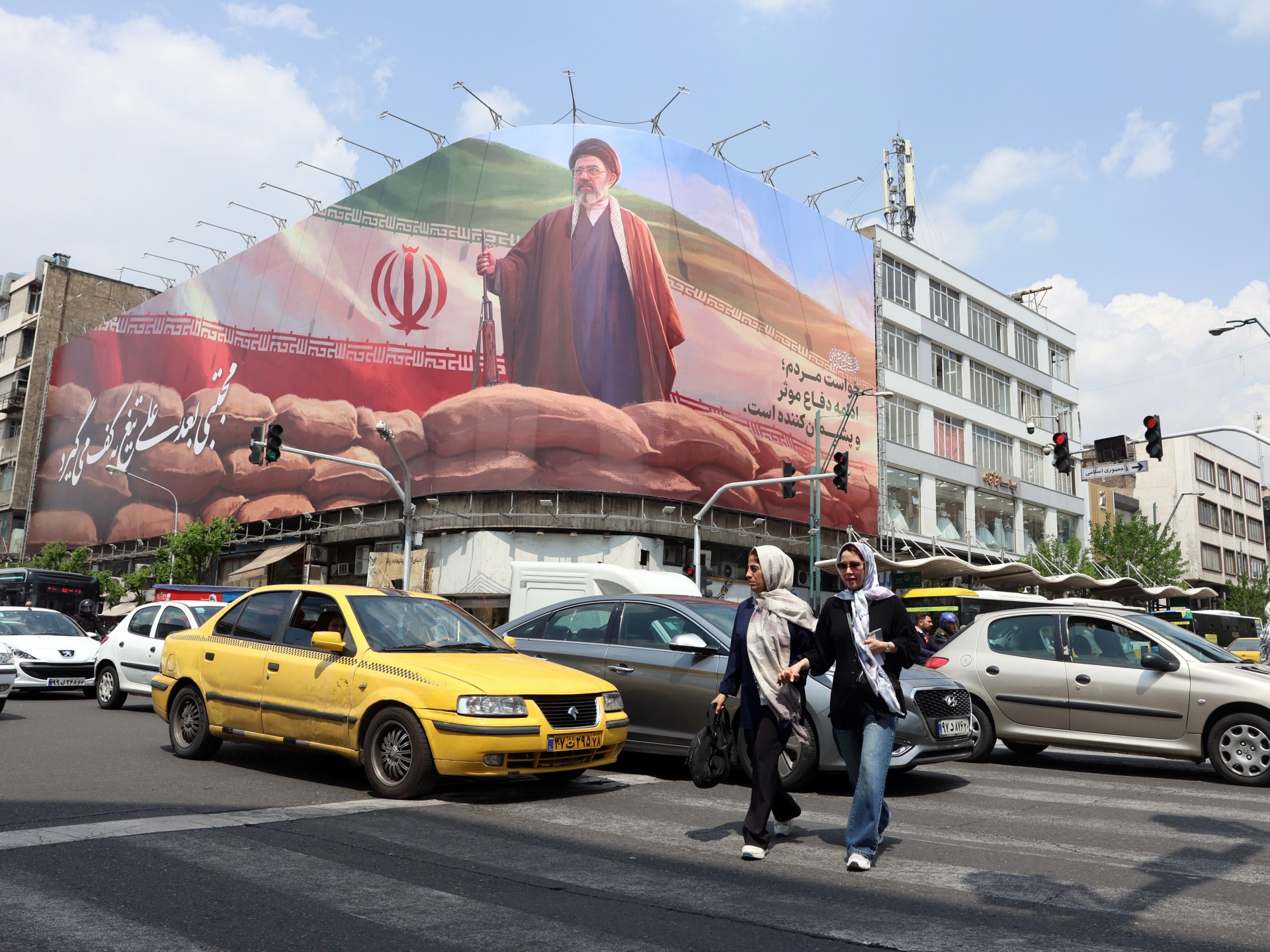

Tehran, Iran – Iran’s authorities and state media project that they are less interested than before the war in negotiations with the United States if they go beyond their accepted terms, as mediated talks failed to materialise in Pakistan.
Foreign Minister Abbas Araghchi met senior Pakistani officials in Islamabad on Saturday and left for Oman, to be later bound for Russia. The top diplomat, who was not joined by Parliament Speaker Mohammad Bagher Ghalibaf like in a previous round of negotiations earlier this month, said he was “yet to see if the US is truly serious about diplomacy”.
- list 1 of 3African governments need to take urgent action on fertiliser shortages
- list 2 of 3After years of avoidance, Trump to attend first White House press dinner
- list 3 of 3Iran FM Abbas Araghchi and Pakistan PM Shehbaz Sharif meet in Pakistan
end of list
Envoys Steve Witkoff and Jared Kushner had been expected in Pakistan after the White House said Iran asked for a second round of direct negotiations, but US President Donald Trump cancelled the trip and said, “we have all the cards, they have none” while reiterating his claim about “infighting and confusion” among Iran’s leadership.
“If they want to talk, all they have to do is call!!!” Trump wrote in an online post, continuing to put the onus on Iran’s leadership.
Amid a state-imposed near-total internet shutdown in Iran, nearing two months, officials and the supporters of the Islamic Republic emphasise that they are united in opposing any concessions to Trump.
The US president said earlier this week he was in “no rush” to reach an agreement with Iranian leadership, whom he claimed, without evidence, were “fighting like cats and dogs” among themselves.
Since Trump highlighted the perceived fractures, military, security, judiciary and government authorities in Iran have been releasing synchronised messages with near-identical wording to proclaim absolute unity.
Advertisement
The messages, circulated through state media and even using similar graphics and fonts but with different colours, claim that everyone in the country is “revolutionary” and exercises “complete obedience” to Supreme Leader Mojtaba Khamenei.
The authorities also claim that more than 30 million people – a third of Iran’s total population – have registered in a state-run campaign to express readiness to “sacrifice” their lives if necessary, but they have not provided any documentation to prove this.
The Khatam al-Anbiya Central Headquarters of the Islamic Revolutionary Guard Corps (IRGC) said on Saturday afternoon that armed forces would retaliate against the US if it continues its “blockade, banditry and piracy” in Iran’s southern waters.
“We are prepared and determined to monitor the behaviour and movement of the enemies in the region and maintain management and control of the strategic Strait of Hormuz, and to inflict more severe damages on the American-Zionist enemies in case of another aggression,” read its statement.
The IRGC on Saturday took a state television presenter to broadcast near two vessels seized days earlier in the strait to report that Iran exercised “total control” over the waterway.

Iranian authorities continue to call on their supporters, including paramilitary forces, to take to the streets every night in order to maintain control.
In a rally in downtown Tehran on Friday night, Meysam Motiei, a prominent state-backed religious singer with links to the supreme leader’s office, told the crowds that anyone stuck in factional infighting during times of war “has not grown up yet”.
“If anyone from any group or faction, especially in the name of being a revolutionary, tries to disturb the unity of the people, they will get a slap in the face by the people,” he asserted.
But in ultraconservative Mashhad in northeast Iran, where a shrine considered holy for Shia Muslims is located along with powerful religious and economic foundations, some were still preaching aggressively against the possibility of former reformist and moderate leaders retaking power.
“They have instructed us to keep unity with incumbent officials, not these two people,” a speaker told a gathering crowd on Friday night in a clip shared by state-linked media, in reference to former President Hassan Rouhani and his foreign minister, Mohammad Javad Zarif.
Advertisement
“We are not afraid of B-2s and B-52s; we are afraid of dishonourables who have no concern for the homeland. Wherever Trump makes a mess, Zarif comes and blabbers away,” he said, about the diplomat who led nuclear talks that led to a now-expired landmark accord with world powers in 2015.
Iran’s judiciary continues to execute dissidents, and on Saturday announced the hanging of Erfan Kiani, who was arrested during the nationwide protests in January when thousands were killed.
The judiciary described him as “Mossad’s hired knife-wielder” and said he was accused of destroying property, arson and more in downtown Tehran.

No nuclear talks?
Iranian state media reports indicate that the US naval blockade of Iran’s ports is undermining the ceasefire extended by Trump and allowing the more hardline voices in Tehran to come out on top.
The Tasnim and Fars news agencies, affiliated with the IRGC, argued against allowing any nuclear negotiations to take place with the US, even though Trump and Israel’s Prime Minister Benjamin Netanyahu started the war with the predominant goal of preventing a nuclear-armed Iran. Tehran has consistently stressed that its nuclear programme is peaceful, although some Iranian leaders have called for the development of a bomb.
“The negotiations with the US are strictly to end the war, and Iran does not consider the nuclear issue to be part of the talks,” Tasnim said, claiming that time was not on Washington’s side due to the tumult in global markets resulting from the war.
Khamenei has not directly commented on more negotiations, but Ali Khezrian, another representative of Tehran in the hardline-dominated parliament, told state media on Thursday that Khamenei was “opposed to any extension of negotiations” under threats from the US and Israel.
Israel’s Defence Minister Israel Katz earlier this week adopted Trump’s apocalyptic messaging, and said armed forces are awaiting a greenlight from the US to “return Iran to the age of darkness and stone by blowing up central energy and electricity facilities and crushing national economic infrastructure”.
There are currently three US aircraft carriers and their supporting vessels in the Middle East region, according to the US military, which marks the first time this has happened since the buildup to the 2003 invasion of Iraq.
But Mahmoud Nabavian, a senior black-turban cleric and hardline member of parliament who was a part of the large Iranian delegation in the first round of talks, said it was a “strategic mistake” to even include the nuclear issue.
He told state media that this allowed the US to raise demands like a 20-year suspension of enrichment, and shipping Iran’s buried high-enriched uranium abroad.
“From now on, entering any negotiations with the US is pure damage and has no interest for the Iranian nation,” he said earlier this week, adding that oil sales were providing the government with a “full hand”.
Advertisement
Mohammad Saeedi, the Friday prayer imam of ultraconservative Qom, located south of Tehran, said in reference to the US that it would be “meaningless and unfair to sit down behind the negotiating table with a symbol of corruption”.

Civilian infrastructure in danger
The government of relatively moderate President Masoud Pezeshkian has signalled concern about the potential impacts of systematic targeting of more civilian infrastructure, especially power plants, in case the war continues.
“We have a simple request from the people: to reduce their consumption of power and energy. For now, we have no need for these dear people to sacrifice their lives, but we need to control consumption,” the president said on Saturday. “They have hit our infrastructure and blockaded us, so the people become dissatisfied.”
Mohammad Allahdad, the head of Tavanir, the government-owned mother company for development and operation of Iran’s power grid, told state television that it would pay a reward to citizens who would report any theft and illegal use of electricity.
First Vice President Mohammadreza Aref said, “We will build Iran back more glorious” through unity after previous infrastructure attacks that hit oil and gas facilities, steel producers, petrochemical firms, aluminium factories, energy facilities, as well as airports, naval ports, bridges and railway networks.
The government reopened Tehran’s Imam Khomeini Airport for limited foreign-bound flights on Saturday, including those taking people to the Hajj pilgrimage in Saudi Arabia, despite the potential of war resuming.
Related News
Top ministers quit after Peru’s president postpones F-16 fighter jet deal
US appeals court extends deadline to halt White House ballroom construction
North Korea launches ballistic missiles towards sea off its east coast