

London, United Kingdom – Sikh groups moved quickly to condemn the murder of 18-year-old Henry Nowak, despite not being responsible for the actions of his killer, 23-year-old Sikh man, Vickrum Digwa.
But the British far right, which increasingly exploits crime cases in order to rally, has weaponised the case.
- list 1 of 3UK minister condemns violent protests against student’s murder
- list 2 of 3UK far-right accused of exploiting killing of Henry Nowak
- list 3 of 3Reform or Restore? The question tearing the UK’s far-right in two
end of list
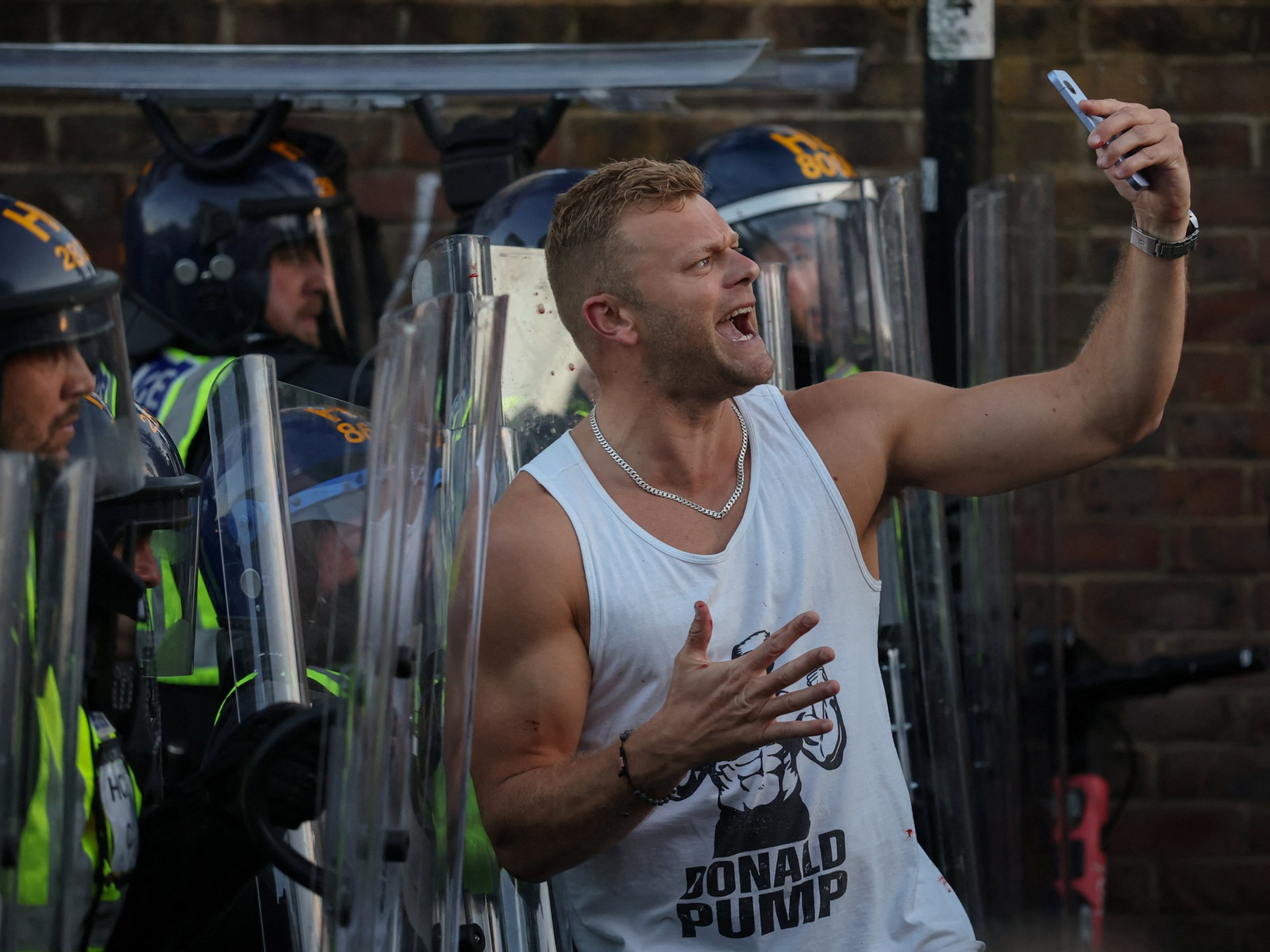
On Tuesday, hundreds of protesters gathered outside Southampton Central Police Station before marching towards Digwa’s family home in a diverse neighbourhood. Several far-right figures, including Stephen Yaxley-Lennon, better known as Tommy Robinson, UKIP leader Nick Tenconi and Laurence Fox, addressed the crowd. Violence broke out, with missiles hurled at police officers and vehicles damaged. Some performed Nazi salutes while shouting “white power”.
“When the news [of Nowak’s murder] broke, there was shock and grief. How could such a senseless individual commit such a murderous attack and be from the Sikh community?” Jas Singh, principal adviser to the Sikh Federation UK, told Al Jazeera.

On Monday, Henry Nowak’s grieving father spoke outside the court that had just sentenced Digwa.
“This is not a case about Sikhism. This is not a case about racism. This is a case about murder,” said Mark Nowak.
On December 3, Henry Nowak had joined friends to celebrate the end of his first term at the University of Southampton. Before the night ended, Digwa, then 22, had stabbed him five times and lied to the police that the teenager had racially abused him.
Advertisement
Officers treated Nowak as a suspect rather than a victim, accepting Digwa’s account. As he lay handcuffed on the ground, Nowak repeatedly told officers he had been stabbed and was struggling to breathe. Police body-camera footage showed his pleas going unanswered.
Mark Nowak expressed his anger at police failures and warned against his son’s death being used to create “further division, hatred or tension”.
Singh, of the Sikh Federation, criticised politicians from the far-right Reform UK and Restore Britain parties for drawing attention to Digwa’s religion and his kirpan, a ceremonial sword or dagger that is one of the five articles of faith for practising Sikhs, arguing that this had fuelled misconceptions about Sikhism. The court heard the murder weapon was not a kirpan but a separate Persian-style dagger that Digwa chose to carry.
A judge told Southampton Crown Court that Digwa brought “shame” on his religion and had stirred up racial tension.
Singh, who has relatives in Southampton, said fears are rising among British Sikhs, many of whom are identifiable by religious symbols such as turbans.
“I was on the phone with people in the gurdwaras [temples] all day until late in the evening. We’ve had so many calls asking, ‘Is it safe to go out? Should we go to the gurdwara?’ Congregation numbers have dropped,” he said.
Some have already reported hate crimes in Southampton. A priest suffered verbal abuse and someone was assaulted in a supermarket, said Singh.
“Then, shockingly, we have a care worker from Southampton who’s been caring for elderly people in their homes for many years. He came to work, and the woman he’d been caring for refused to let him provide care because he was a Sikh in a turban and beard. That’s the level to which this hatred has now become ingrained,” he said.

Jayanti Shah, an antiracism campaigner who has lived in Southampton since 1968, said the atmosphere in the city has been deteriorating since 2024, when race riots swept across the country after the murder of three girls in Southport, in northern England.
“For the past two years, I haven’t gone out in the dark as a safety measure,” he said, adding that recent demonstrations “caused havoc” and made residents scared to leave their homes.
Ali Haydor, a taxi driver in Southampton, said far-right demonstrations are not a new phenomenon in the city and have erupted before over a nearby hotel housing asylum seekers. He has also suffered an increasing level of racist abuse from passengers.
Advertisement
“We are used to marches, but what happened the other night was different,” he said. “It was much more confrontational. It felt like people were being directly targeted.”
The tensions have already affected families.
A community Eid celebration was postponed over safety concerns, parents are making alternative arrangements to avoid unnecessary travel, and an Afghan pupil at a local school was subjected to a racist slur.
“People of colour are doing things differently now,” Haydor said. “Children are getting lifts home from school instead of walking. People are avoiding public transport where they can.”
‘All sorts of verbal and racial abuse’
Jas Singh says there are fears outside of Southampton too, having received several reports of anti-Sikh hate crime elsewhere in the country in the last few days.
“We’ve had people being spat on in Kent. A chap in Birmingham was going to work and was shouted at with comments like, ‘He’s got a knife,’ along with all sorts of verbal and racial abuse.”

He accused the government of neglecting the Sikh community and failing to ensure their safety.
“Not reaching out to Sikhs to provide assistance, support or protection – support that we have seen offered to other communities – is concerning. We are providing protection around our gurdwaras ourselves. We are protecting our elderly as much as we can,” he said.
He noted recent examples in which Sikh Britons were victims of racist crimes, all in the Midlands, such as two cases of rape in the Midlands and the assault of a pensioner last month.
Two-tier policing
Nowak’s murder has reignited a debate over “two-tier” policing.
Nigel Farage, Reform UK leader, said, “We are living in a two-tier Britain where the rights and privileges of white people matter less than those of ethnic minorities.”
He urged the public to react with “pure, cold rage”.
On Thursday, the United States, often critical of Labour leader Keir Starmer’s government, waded in, with the State Department posting on social media, “Ideological conditioning and two-tiered policing are glaring symptoms of civilizational decline. They must be rejected across the West.”
The debate has renewed calls for an overhaul of diversity, equality and inclusion (DEI) guidance within policing.
Shabna Begum, head of the Runnymede Trust, a race equality think tank, said political exploitation of murders is not new, “but the febrile context in which it is currently advanced makes it exceptionally dangerous”.
“The knee-jerk reaction of police leaders and politicians hurriedly committing to reviewing anti-racism guidance betrays the fact that decades of inquiries and reports have found that these efforts have made little to no difference to the over-policing of communities of colour – especially young Black men. Black people are seven times more likely to die following police restraint in Britain. There is two-tier policing – but not one that favours communities of colour,” she said.

There is no evidence that antiracism guidance had over-corrected police behaviour, she said, warning that such claims, which far-right figures have made, risk undermining decades of civil liberties and equality work.
Advertisement
Andrew George, president of the National Black Police Association, told Al Jazeera, “The suggestion that policing has somehow gone too far in addressing race and inclusion is not supported by the evidence.”
He said it was “telling” that some of the strongest calls to dismantle engagement and inclusion initiatives are directed towards work focused on minority ethnic communities.
“Policing depends upon legitimacy,” he added. “We need people from every background to trust us enough to report crime, share information, act as witnesses and work alongside us to prevent harm. Building trust with communities is not a distraction from policing; it is fundamental to effective policing.”
Related News
‘I was actually depressed’: France tries to deport immigrant students
Israel is building more military posts in Gaza, satellite imagery shows
How Nigeria’s ‘algorithmic apothecary’ fuels a surge in risky herbal cures