
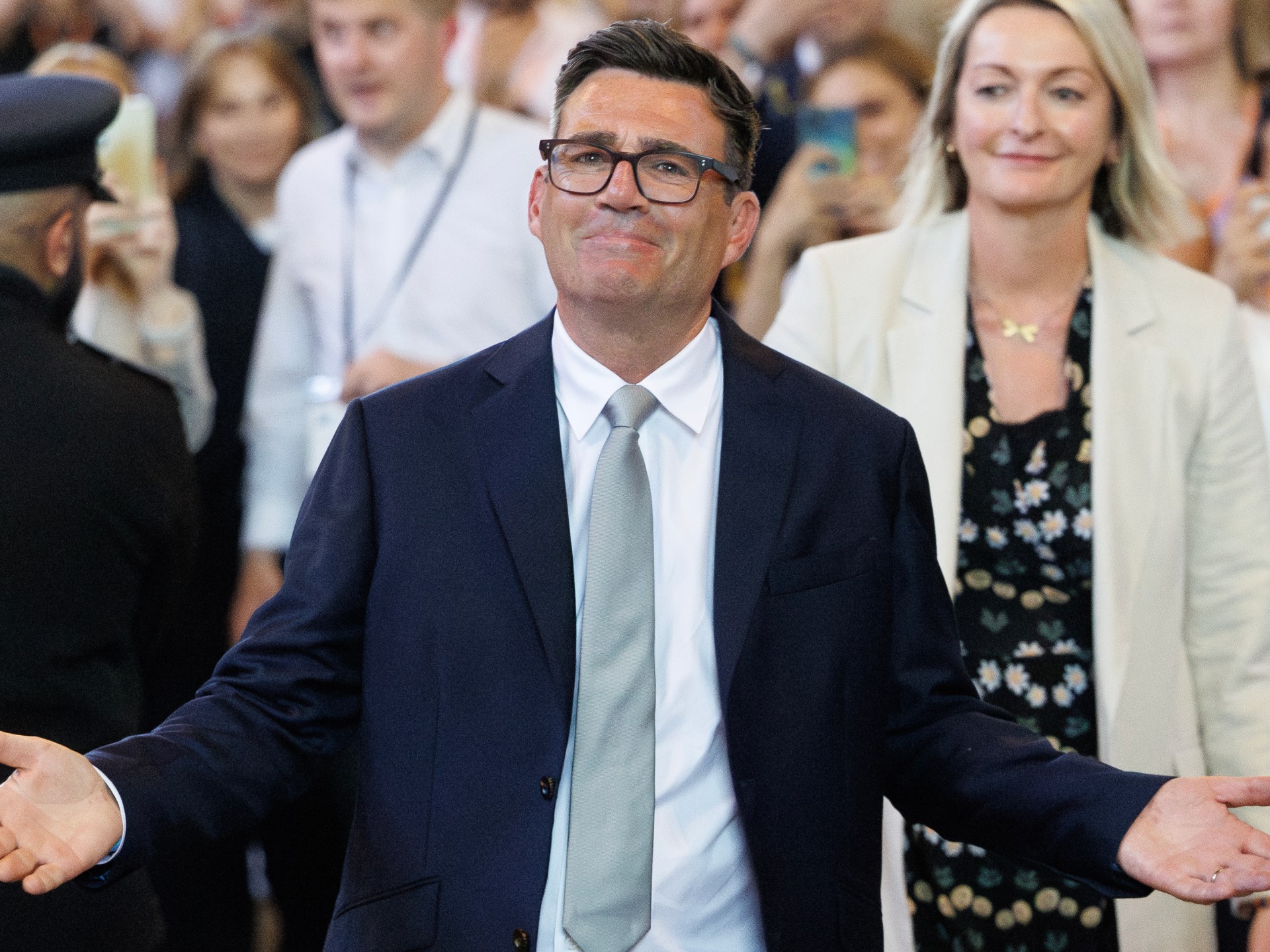

British politician Andy Burnham is tipped to become the UK’s next prime minister, after Keir Starmer announced his resignation last week amid intense pressure from his own Labour Party
Burnham, who served as mayor of Greater Manchester since 2017 and won the Makerfield by-election earlier this month, could take the reins of a party that has been haemorrhaging votes, after disastrous local elections in May.
- list 1 of 3‘I leave the biggest job’: Keir Stamer’s resignation speech in full
- list 2 of 3Political turmoil: UK will see its seventh prime minister in 10 years
- list 3 of 3Starmer set to resign as UK PM: How does a leadership contest work?
end of list
As Burnham promises a leadership challenge to replace Starmer – the most unpopular prime minister since polling began in the late 1970s, he will be forced to consider the party’s stance on Israel and its genocidal war on Gaza.
Patrick Diamond, lecturer in public policy at Queen Mary University of London, UK, said it was too soon to tell whether the party’s foreign policy on Israel will shift dramatically should Burnham become prime minister.
“Burnham would seek to urge all sides in the conflict to get around the negotiating table, and to end the violence as quickly as possible,” Diamond told Al Jazeera. “He will certainly be mindful of the danger of losing voters over the Gaza issue.”
Local elections showed Labour lost more votes to the left-wing Green Party – which views Israel as an “apartheid” state and its military operations in Gaza as “genocide” – than to the far-right, anti-immigration party Reform UK.
Additionally, polling commissioned by Save the Children UK, Christian Aid, and Medical Aid for Palestinians suggested that more than 60 percent of Labour Party members were dissatisfied with the government’s response to Israel, with the majority backing tougher measures, including the suspension of all UK arms exports to Israel.
Advertisement
Nimer Sultany, lecturer in public law at SOAS University of London, UK, said Burham’s overall position has not differed significantly from Starmer’s, with the exception of his call for a ceasefire in Gaza on October 27, 2023, when he broke ranks with the Labour leadership alongside London mayor Sadiq Khan and Scottish Labour leader Anas Sarwar.
According to Sultany, Burham will be unlikely to stray far from Labour’s set policies. “We can expect continuity, not a break from current British policy toward Israel,” he told Al Jazeera.
Where does Burnham stand on Israel-Palestine?
Burnham’s position is unclear.
“Having been a regional mayor for the last decade, Burnham hasn’t been heavily involved in foreign policy, so it is difficult to say exactly what his position is,” Diamond said.
Critics have accused him of shifting position when convenient, branding him a “political weathervane” or a “flip-flop”, while supporters depict him as a pragmatist whose ear is attuned to the demands of the people.
In 2012, he visited the occupied West Bank with Labour Friends of Palestine, a pro-Palestine group within the party. But in 2015, he joined Labour Friends of Israel. The same year, he unsuccessfully ran to become Labour leader, pledging to travel to Israel as his first visit abroad.
Benjamin Netanyahu’s 2015 re-election as Israeli prime minister met disappointment from Burnham, who described it as “depressing” for his “pledge to build more settlements” in the occupied West Bank. “Palestine will need more international support,” he said on X at the time.
The same year, Burnham was also among a handful of British politicians who backed recognising Palestinian statehood, describing it as “a right” while slamming illegal Israeli settlements’ expansion as “key obstacles” to a two-state solution.
At the same time, he opposed boycotting Israel, saying efforts in this regard were “the wrong response”.
Upon becoming mayor of Greater Manchester in 2017, Burnham described Israel as a “democracy that has a long history of protecting minorities and promoting civil rights.”
In the run-up to the Makerfield by-election last week, where Burnham held off a challenge from Reform UK, he refused to describe Israel’s military campaign in Gaza as a “genocide”.
“I can’t judge things of that enormity from where I am as mayor of Greater Manchester,” he said. “But I do have concerns about the disproportionate nature of what has happened in terms of the destruction, and there has to be a full process of investigation and accountability.”
Advertisement
Amid symbolic actions including recognising Palestinian statehood and issuing sanctions against some settlers or government ministers, one can expect the Labour Party to avoid acting “against a rogue and outlaw state that has undermined international law and violated international courts’ orders,” said Sultany.
What has Burnham said so far on foreign policy?
Burnham has unsuccessfully run for Labour Party leader twice, in 2010 and in 2015. Before becoming Manchester mayor in 2017, he was Labour’s shadow home secretary at a time when the United Kingdom voted to leave the European Union.
In his last conference speech before quitting the role to focus on the mayoral race, he said Labour could not afford to ignore voters’ concerns about immigration but must “fully face up” to the fact that its supporters wanted “change”.
Burnham has since criticised the UK’s exit from the European Union, known as Brexit, and said he hoped to see the country rejoin the bloc. Last year, he criticised his own party for failing to “call out” the economic damage Brexit had done.
He has staunchly supported the transatlantic alliance, NATO, refusing to serve under former Labour leader Jeremy Corbyn when he pledged to leave the alliance if elected.
While in 2003 he voted consistently in favour of the UK’s military intervention in Iraq alongside the US, in 2023 he said that while there had been a case for removing Iraqi leader Saddam Hussein, the joint operation “resulted in huge harm to innocent civilians.”
“If the response to 9/11 was supposed to root out terrorism, it is hard not to conclude it did anything but,” he said. “I can’t justify the rage, the rhetoric, the haste with which it was done, nor the lack of a plan for the aftermath.”
Earlier this month, Burnham appeared critical of US President Donald Trump, while avoiding openly naming him. Americans are experiencing “a polarised, poisonous politics where people in communities don’t work together anymore”, he said. “The path we’re on, if we are not careful, is a path towards the politics of the United States of America.”
Following a spat between Trump and Starmer, he defended the British prime minister for refusing to allow US troops to use UK bases to launch attacks on Iran: “Normally, you would want a good relationship with the US, but if you can’t agree with them, then say that, as well.”
Last week, Trump described Burnham “extremely liberal, extremely, so that means he probably won’t open up the North Sea” for drilling oil.
UK continues to ‘undermine’ domestic rule of law
Burnham is understood to be following Starmer’s line also when it comes to curbs on undocumented migration, including ending the right to permanent refugee status.
He has signalled his intention to retain Shabana Mahmood as home secretary, in a sign of support for her attempts to limit legal and undocumented migration that several Labour members had hoped might soften.
Mahmood has faced criticism over the proscription of Palestine Action, the activist group that was labelled a “terrorist” organisation last year.
Advertisement
The home secretary has pushed for stricter asylum policies that could affect individuals without the right to remain in the UK.
Sultany, at SOAS, said keeping Mahmood in her post would be a marker of continuity.
“The government continues to undermine the domestic rule of law to cover up the fact that it is undermining the international rule of law, by encroaching upon the right to speech and protest of those who are reminding the government of its legal obligations to prevent genocide and dismantle apartheid,” he said.
Related News
Colombia’s new president takes office vowing to ‘crush’ narco-terrorism
PA activists face ‘terror’ charges over Trump golf resort protest: Report
Iran, Gulf hit as Hormuz, Bab al-Mandeb close: What’s the latest?