
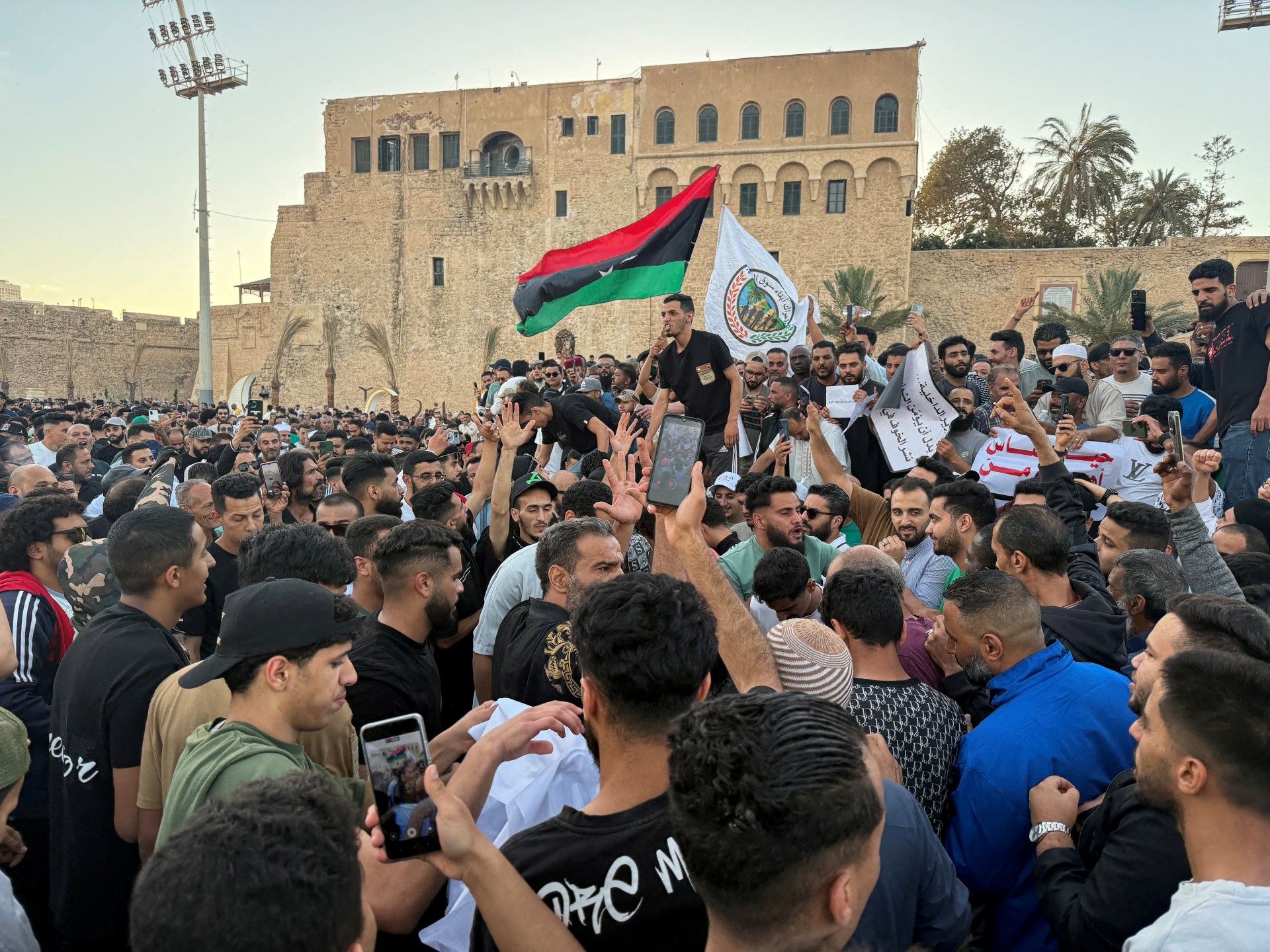

Protesters in Libya’s capital, Tripoli, have shut down roads and public buildings across the city as a civil disobedience campaign, launched over prolonged power cuts and high electricity rates, spread to more districts.
Crowds blocked the coastal road in Janzour, west of Tripoli, late on Sunday, and gathered outside the West Tripoli power station, closing the local municipal council building in protest at the prolonged outages.
- list 1 of 4Turkiye and Libya’s Haftar are boosting military ties. Is Egypt worried?
- list 2 of 4Oil for unity: What is the US mediation plan in Libya?
- list 3 of 4Marco Rubio meets Libyan commander as US pushes to resolve Libya crisis
- list 4 of 4Which Middle East nations have nuclear programmes, and how were they built?
end of list
Videos posted online, verified by Al Jazeera shows, protesters burning tyres and closing down major roads elsewhere in the capital.
The footage also shows protesters unloading a truck loaded with dirt in front of the Ministry of Foreign Affairs in the district of Sater Turba in Tripoli to close it.
The mostly young protesters also shut the offices of state telecoms operator Libyana in the district of Souq Al-Jumaa, according to the DPA news agency, carrying banners criticising Prime Minister Abdulhamid al-Dabaiba.
The campaign was launched by the Souq Al-Jumaa Movement, which has opposed the Government of National Unity since May 2025. It said its aim was to “completely paralyse the government” rather than disrupt ordinary life.
It called for accountability over alleged corruption and for the dissolution of Libya’s existing political institutions, including the government, the House of Representatives, the State Council and the Presidential Council.
The unrest also spread to the district of Tajoura, where the Tajoura Families and Youth Movement said it would begin a full boycott of state institutions from Monday, rejecting both the unity government and the House of Representatives.
Advertisement
It said in a statement that the call was in protest against the deterioration of services, citing the decline in electricity, water, education and health services, alongside continuing fuel and liquidity crises and medicine shortages, while “officials are preoccupied with political conflicts”.
There was no immediate comment from the Government of National Unity.
Blackouts in Tripoli and other areas have reached up to ten hours a day, prompting the state-run General Electricity Company to reinstate load-shedding measures after two years of relative network stability.
The outages have compounded existing public frustration over inflation, currency instability, fuel and liquidity shortages, and Libya’s protracted political deadlock.
Separately, Massad Boulos, the White House adviser for African affairs, said he had held a “productive call” with Dabaiba on Sunday to discuss steps toward Libyan unification, including security cooperation between the country’s eastern and western factions.
“We also reviewed opportunities to further coordination and interoperability between Libyan forces and Africom,” Boulos said on X, adding that Washington remained committed to supporting Libya’s unification “in order to achieve durable peace, stability and prosperity”.
Related News
America250: How the US heatwave will affect Fourth of July celebrations
US attacks Iran for tenth consecutive night
Dodging snipers, housing crisis forces Yemenis to live on front line