
Hundreds camp on sweltering Rome street amid tussle over squatted building
 08 August 2026
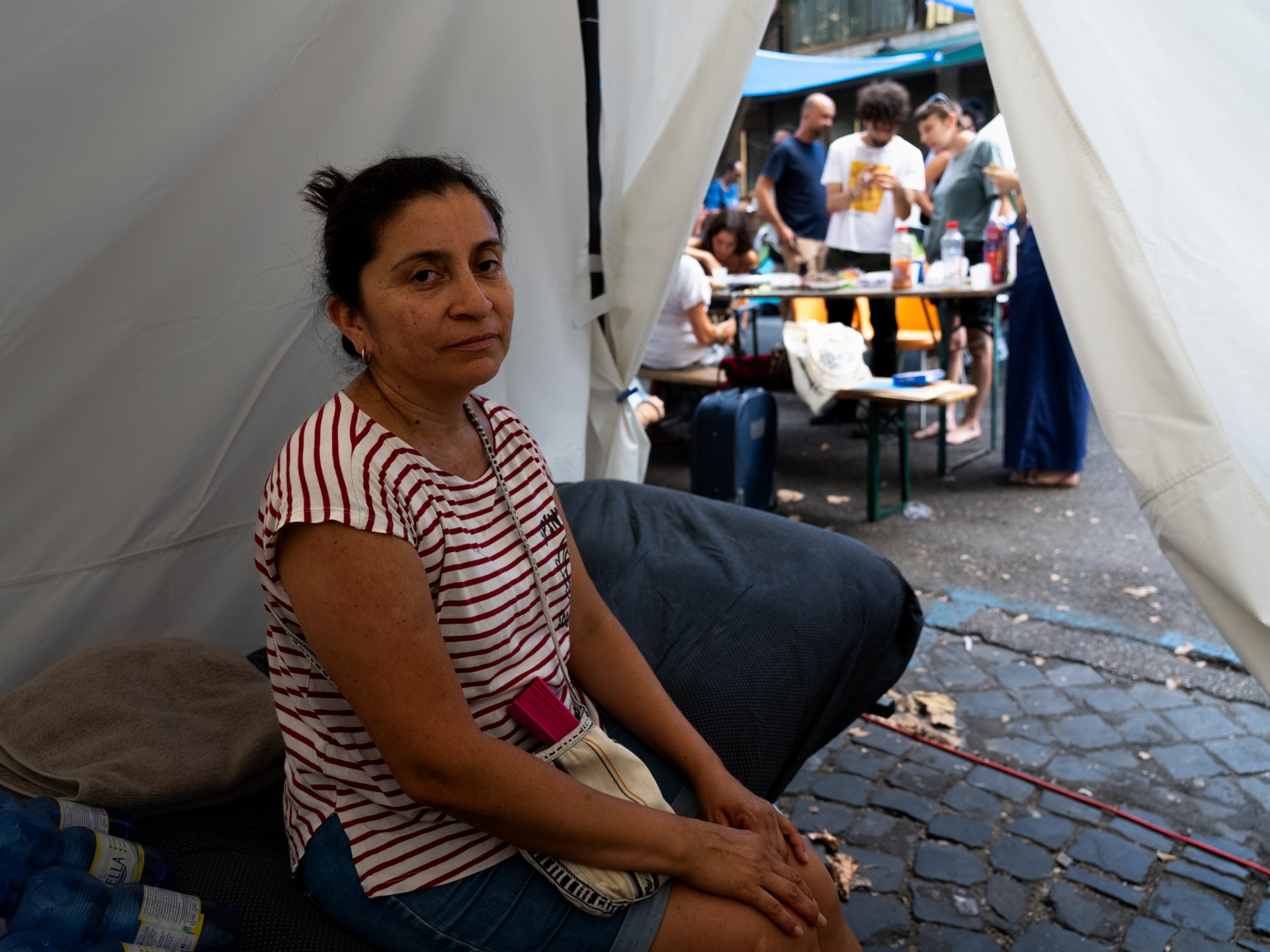

Rome, Italy – Ana Bizdoaca has stopped expecting to be able to sleep on a mattress on the pavement a few streets from Rome’s Termini station. A heatwave has pushed temperatures past 40 degrees Celsius (104F).
“Our hearts have been torn to pieces,” Bizdoaca said on the ninth night of missing sleep.
- list 1 of 4A safe space for Gaza women: A sanctuary to speak, heal and share amid war
- list 2 of 4Dangerous summers: How heatwaves and wildfires change life across Europe
- list 3 of 4Spain imposes border checks on Italy as countermeasure in Ceuta spat
- list 4 of 4Pope Leo urges migrant protection, integration on visit to Lampedusa
end of list
Around her, some 300 people, including vulnerable people and about 100 children, from across the world, are doing the same.
Behind them stands the seven-storey former office block known as Spin Time, a squatted building where they all lived until days ago. Bizdoaca has lived there since 2013.
First occupied in 2013, it became home to many, including 140 families from more than 20 countries. It started with a simple idea at its centre: housing as a fundamental right.
The residents have been outside since July 29, when a small fire broke out in the evening in a lower floor room where nobody lived. Residents put it out within minutes, before the fire brigade arrived, and the damage was minimal.
Police evacuated the building and magistrates placed it under judicial seizure. It was declared unfit, and residents are now let back in one at a time, escorted by police, only to collect documents and essentials.
The pavement has become home to the sit-in.
Food arrives at lunchtime from volunteers in the surrounding district, along with water, mattresses, and clothes. Thousands have passed through over the past nine days, including dozens of politicians, singers and actors. In the evenings, an open-air cinema gives the camp’s children something to watch other than the street.
Advertisement
On the first night, many did not have shoes. At 4am, they were told they would not be let back in.
“Some of us were on our feet for 40 hours,” said Maria Cabrera, who has lived in the building for almost 11 years and helps organise the camp.
“Seeing the children on the ground, on flattened cardboard from the bins, it was awful. It really was.”
On August 6, a two-year-old girl fainted in a Red Cross nurse’s arms.
“I cried for two hours,” said a Kurdish resident, who watched the scene unfold.
She told Al Jazeera that her brother, also a resident of the building, is blind and uses a wheelchair. Neighbours used to check on him while she was at work. Now, he sits under the scorching sun.
The community has drawn support from well beyond the neighbourhood.
On Friday, the physicist Giorgio Parisi, who won the Nobel Prize in 2021, sent the residents a letter.
“Inequality and marginalisation are the woodworm eating away at our democracy”, he wrote, “and we should all be on the side of those who fight them concretely, not just in words”.
‘It became a family’
Cabrera arrived a year after losing her job, having been unable to pay rent.
“At the beginning, it wasn’t simple, because there are 27 different nationalities here,” she said. “But it became family. Whoever is on my floor, I can go and ask them for anything.”
One of Rome’s most active cultural spaces, Spin Time has a free co-working area, a newspaper put together by people aged below 30, and hosts concerts and plays.
Cabrera saw her first classical music show here.
“Things I could never have afforded outside,” she said.
In 2019, the building made headlines worldwide when the pope’s almoner, Cardinal Konrad Krajewski, descended into a manhole to restore electricity, which had been cut due to mounting debts.
An irrevocable no
On August 3, Rome’s prefect convened the mayor, police chief, housing councillor and Cardinal Baldassare Reina, vicar general of the Diocese of Rome.
The city offered to buy the building from InvestiRE SGR, the fund that manages it, with an interim arrangement that would let residents return while the sale went through.
Another meeting was held on Thursday. Mayor Roberto Gualtieri announced live on television that the offer had been rejected.
“I’m not happy, and I’m somewhat irritated,” he said, adding that the Church had done everything it could to persuade them.
The city is now working on an alternative.
In a statement issued late on Thursday, InvestiRE SGR said that the inspection confirmed that after 13 years of occupation, the building does not meet safety standards and that this legally precludes handing possession to the city, thereby ruling out any interim arrangement.
Advertisement
The company added that it remains willing to continue talks towards selling the building.
Gualtieri said the city would be able to place residents in dignified accommodation from Monday, and that the first housing assignments could begin within 60 days for households that qualify.
But the activists, who want to stay, say they will hold the sit-in as long as possible to pressure the local government.
The fund has long planned a luxury hotel on the site, and Spin Time has for years been listed by the government as a site to be cleared.
The governing right-wing Brothers of Italy party pressured the mayor not to proceed with the purchase, saying using public money as thousands wait on housing lists would reward illegality.
“We never thought they would use this tragedy” to evacuate the building, Aurora Jacob, another resident, said of populist forces. “Someone took advantage of an emergency, of the vulnerability of families and children, to push them out of their homes. The difference between us and you is that we are second-class citizen.”
‘I don’t think being poor is a crime’
The Vatican is now watching from a distance.
Pope Leo XIV recently received members of the community. Cardinal Reina has said the pope asks to be updated hour by hour.
If a permanent eviction goes ahead, Spin Time would be the largest occupation to face such measures in Italy.
Asked what she wants now, Cabrera does not hesitate.
“A miracle,” she said. “I don’t think being poor is a crime.”
The authorities should stop playing with people who need help, she said, and the owners should finally sell.
“Everyone is just speculating, on the price of a building and on us, on people going through difficult times.”
She gestured back at the dark windows above the mattresses.
“It’s not a luxury home. We put up four walls,” she said. “But for us, that is home. And we want to go back.”
Related News
Trump administration attacks US left, alleging Cuba ties: Key takeaways
Russia’s Africa Corps killed Mali civilians in air strike: HRW

Serbia’s protesters press on even after Vucic promises to step aside