

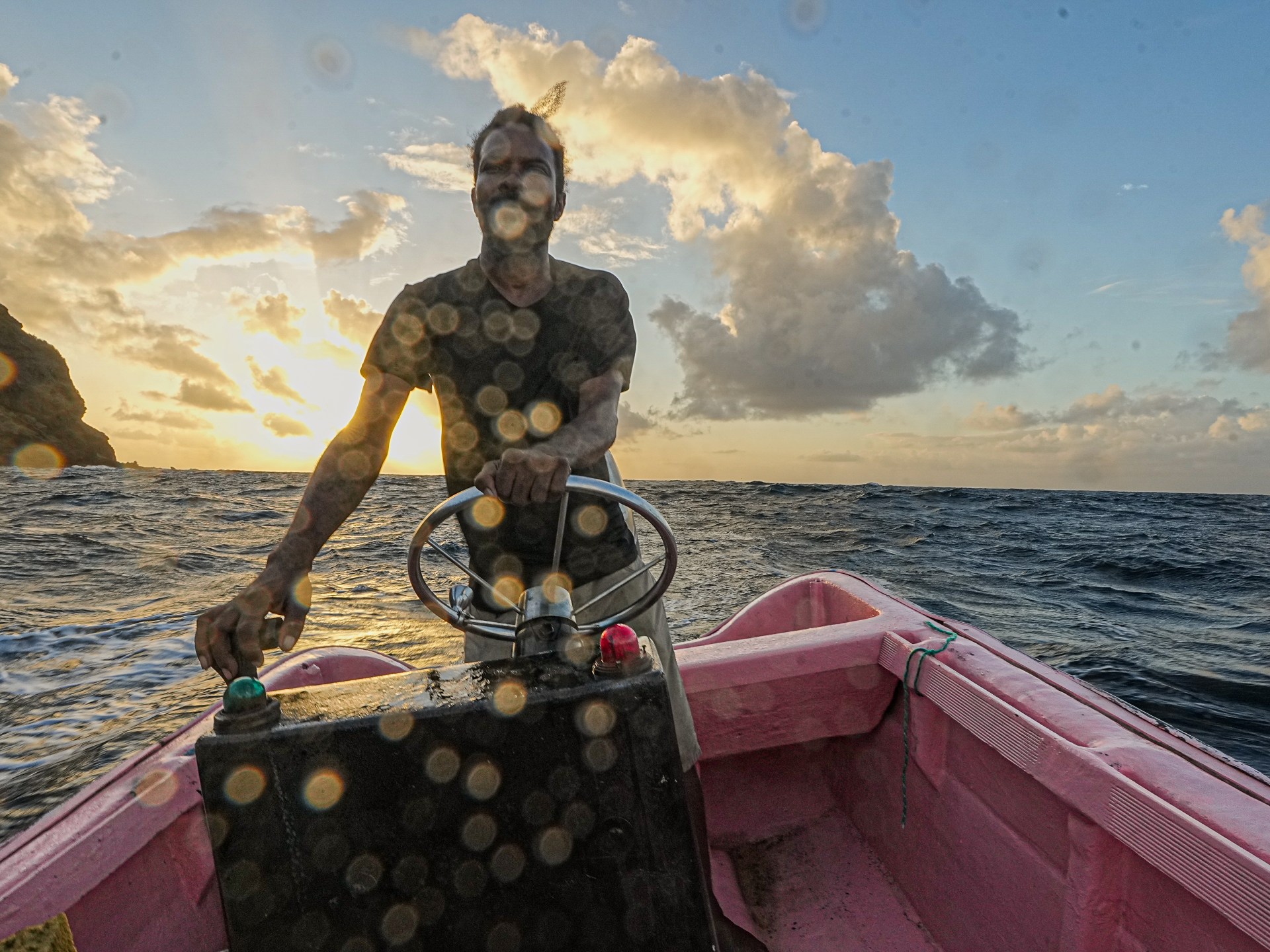

Rayshawn Charlery stands on a dock in Saint Lucia, his heavy-lidded eyes looking out at the colourful Caribbean fishing boats dotting the bay. He last saw his father, fisherman Joseph “Nathy” William, a week before his disappearance in February.
On February 13, William went fishing with Ricky Joseph, a father of four. Neither returned home. Charlery could no longer reach his father.
- list 1 of 3US military kills two people in new eastern Pacific Ocean attack
- list 2 of 3Trump says US strike killed Tren de Aragua gang boss with Venezuelan help
- list 3 of 3US military says strike on alleged drug-smuggling boat kills two
end of list
That same day, the United States military released black-and-white drone footage of a strike on a small vessel in the Caribbean Sea, saying it had killed suspected narcotics traffickers.
Charlery has doubts about that account. He fears the slender boat may have been a fishing vessel – namely, the one his father was using the day he went missing. His father, he says, was not a drug smuggler.
“All I know is that my father is a fisherman, and he went out to sea and never made it home,” Charlery told the Al Jazeera programme Fault Lines. “He’s just an honest fisherman.”
Charlery’s father left behind two children and an elderly mother he had been caring for.
Since September 2, 2025, the administration of President Donald Trump has carried out dozens of bombings against unidentified vessels in the Caribbean and the Eastern Pacific, killing more than 220 people it labels as “narcoterrorists”.
In each case, there has been no court filing, no trial and no public effort to identify the victims. For families like Charlery’s, there have only been images of smoke, silence and the sea.
Experts say the strikes likely amount to extrajudicial killings, which are illegal under international law.
Advertisement
Fault Lines investigated the cases of three missing fishermen and spoke to the families they left behind to offer a window into the human cost of a campaign carried out with little transparency or accountability.
Other families that Fault Lines approached would not speak publicly, for fear of repercussions.
Like Charlery, Ricky Joseph’s family also tried to contact him but could not reach him. Other fishermen sent Titus Joseph, his brother, videos of boat wreckage circulating online. Titus instinctively knew whose vessel it was.
“I said that’s my little brother that was captaining the boat,” Titus told Fault Lines, calling Joseph his “backbone”.
Ricky often supported his family with the few thousand dollars he earned from fishing each year, according to his partner Lucillia Charles. He was the sole breadwinner, providing for her and the children.

Neither Charlery nor Charles was able to get answers from local authorities or the US government about what happened to their loved ones. Both say they went to the police to file a missing persons report. They did not hear back.
Fault Lines asked local police in Saint Lucia for answers about both cases, but they did not respond. It also approached Saint Lucia Prime Minister Philip J Pierre about the fishermen’s disappearance.
“We still consider it a missing persons case, and our own law enforcement are trying their best to see if they can decide what happened. But as far as we’re concerned, the United States have given us no information on that one,” Pierre said.
What makes Joseph and William’s case unique is that police have the remains of their boat – one of the few pieces of physical evidence preserved from the US strikes.
Fault Lines was able to see the wreckage in person, behind a police building, where for months weeds had grown over it. Its team also tracked down the boat’s owner to determine whether it was the vessel Joseph and William had been on board.
Cameron Tayliam, the owner of Zouti Boats, said he was able to recover the remains of the boat before it sank.
He added that he recognised the boat as one of his own by its colours: green on the outside, black on the bottom and red on the inside.

But even with the remnants of the boat, experts say justice may be difficult to come by.
To date, the US government has not published the names of those killed in the boat-bombing campaign, nor has it provided any public evidence to justify the attacks.
Advertisement
Instead, Trump has repeatedly claimed that the boat bombings save lives by preventing illicit drugs from reaching US soil. “Every boat that we knock out, we save 25,000 American lives,” he said last October, without providing proof.
In an unreleased memo obtained by US media, Trump has also claimed the country is in a “non-international armed conflict” with drug-trafficking organisations.
The memo directed the US military to “conduct operations” against such groups, despite the fact that Congress has not signed off on such actions.
Amanda Klasing, the national director for government relations and advocacy at Amnesty International USA, is sceptical of Trump’s rationale.
“There is no evidence that the people that are being killed in this campaign have any means by which they could cause harm or violence against Americans. They have no intent to invade the United States,” Klasing said.
Former US Army captain Margaret Donovan, who served as a lawyer in the Judge Advocate General’s (JAG) Corps, also told Fault Lines she sees no apparent legal justification for the boat strikes.
“In order to use lethal force against anybody in a military setting, you need to have congressional authorisation or some [need for] imminent self-defence,” Donovan said.
In cases of self-defence, she explained, “the executive can temporarily authorise lethal force later to be confirmed by the Congress”.
But under international law, drug trafficking is not akin to a military attack. It is also not understood to be justification for an act of lethal self-defence.
It is a crime, and authorities have long addressed the problem by intercepting boats and arresting suspected traffickers.
Trump, however, has argued that such interdiction efforts are ineffective. But experts like Donovan warn that summarily killing people in international waters, without a trial or due process, is illegal.
“If you’re looking at it from a domestic legal perspective, it’s murder. If you’re looking at it from an international legal perspective, it’s a war crime,” said Donovan.
At least two legal challenges are being heard against the boat bombing campaign. One is being led by the families of two Trinidadian men, who disappeared after an October 14 strike. That case is being heard in a US federal court.
The other concerns Alejandro Carranza, a Colombian fisherman who disappeared off the coast of La Guajira on September 15, 2025.
In December, Carranza’s family filed a complaint with the Inter-American Commission on Human Rights, arguing the fisherman’s rights to life and due process had been violated.
Carranza’s friend, Leonardo Vega, saw the video Trump had posted of that day’s strike and connected his disappearance to it.
“We have no doubt. Time has passed, and nothing more was ever heard of Alejandro,” Vega told Fault Lines.
Though Trump identified the victims as “narcoterrorists from Venezuela”, Vega said he knew otherwise. “We, as fishermen, realised it was a Colombian vessel.”

Carranza’s partner, Katerine Hernandez, told Fault Lines his family initially hoped that Carranza had jumped into the water to escape the blast. As time went on, they waited for his body to be found.
Advertisement
“At one point, I wondered whether they could recover even a finger or something, but I don’t know. There is nothing left,” she said.
Hernandez explained that Carranza had called his family before setting sail one last time. She forcefully denies the Trump administration’s accusations of drug trafficking.
“If he really was a narcoterrorist, as they say, why didn’t they pursue him, capture him and prove that he was a narcoterrorist? And if he had been a narcoterrorist, we would have had money, property, an inheritance — something,” Hernandez said.
Fault Lines reached out to the Defense Department, the State Department, the White House and US Southern Command, which oversees military operations in Central and South America, to confirm whether Carranza, Joseph or William were killed in the strikes.
They did not respond to questions about the identities of those killed.
In a written statement, the White House said, “All of these decisive strikes have been against designated narcoterrorists bringing deadly poison to our shores.”
US Southern Command, meanwhile, said it “will not comment on individual cases, including narcoterrorists killed in kinetic strikes”. It also defended the legality of the boat bombing campaign.
“All kinetic strike operations are conducted under strict lawful authority, based on comprehensive intelligence and established targeting criteria,” a spokesperson said.
The strikes, meanwhile, have continued. On August 23, US Southern Command announced that an attack on a “low-profile vessel” killed two people. Two days later, another strike killed four. No victims were identified in any of the cases.
For families, the lack of transparency has brought uncertainty and grief. Relatives who suspect their loved ones may have been killed lack the closure that official confirmation — or a body — can bring.
Charlery feels like the US has taken “a piece” of him. He continues to grapple with the disappearance of his father.
“It’s sad that there is no body to bury,” Charlery says. “Sometimes I wonder if there is justice.”
Related News
Japan has record 100,000 people aged over 100: How societies are ageing
Qatar’s emir urges diplomacy as Gulf at ‘one of the most dangerous phases’
Missouri Supreme Court blocks Trump-backed map from November’s midterms