
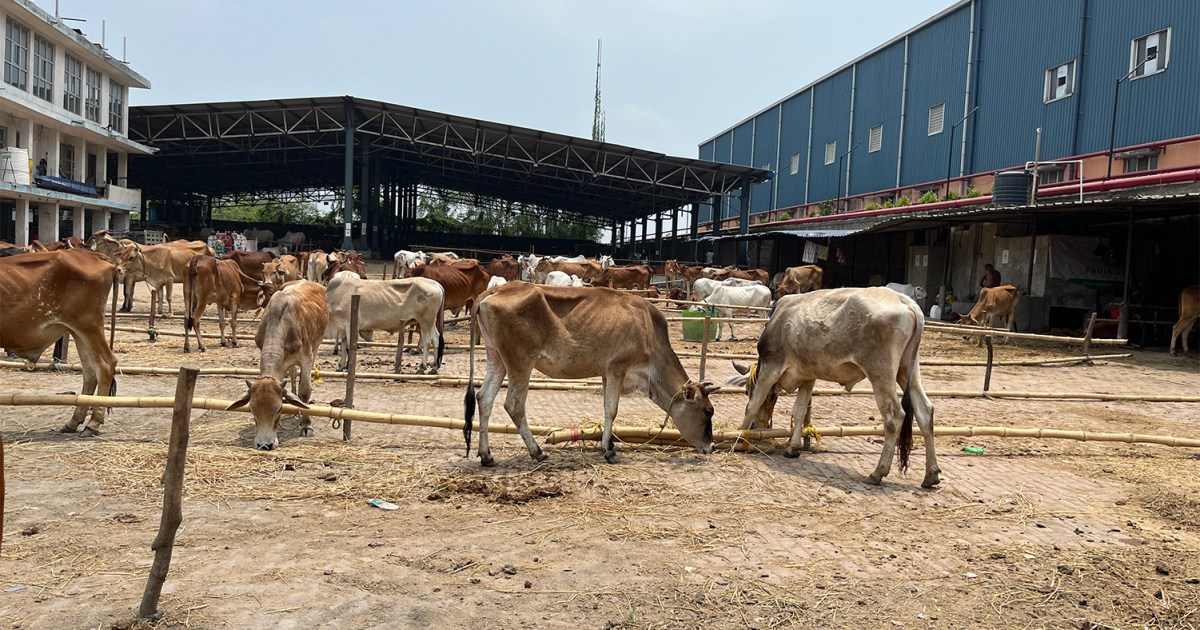

Kolkata, India – Less than a week before Eid al-Adha, the sprawling Dhulagarh cattle market on the outskirts of Kolkata, the capital of India’s West Bengal state, has a deserted look.
Traders are huddled in groups under a tin shade while more than 200 head of cattle readied for sale before the Muslim festival remain tied to bamboo poles in the open, braving the summer heat.
- list 1 of 4What Modi’s big win in Indian state elections could mean for its democracy
- list 2 of 4What is Hindutva, and what are the roots of this political movement?
- list 3 of 4‘Cockroach Janta Party’: Top Indian judge’s comment sparks satire, protest
- list 4 of 4The BJP’s Bengal victory exposes the erosion of Indian democracy
end of list
But there are no customers in sight.
A Hindu seller, who had come to the market from East Midnapur district, 130km (81 miles) southwest of Kolkata, tells Al Jazeera he has taken out multiple high-interest loans to buy his stock for the festival, which falls on Wednesday and Thursday. In a state with nearly 25 million Muslims, or 27 percent of its population, it should be an occasion for good business.
But, he says, this year is different.
“Who will buy a cow? People are living in fear,” the Hindu seller says on condition of anonymity because he fears reprisals from the authorities.

For decades, the Dhulagarh cattle market was visited by sellers – almost all of them Hindus – and Muslim buyers to prepare for a ritualistic sacrifice to mark Eid al-Adha. Besides a goat or sheep, many Muslim families often pool together money to sacrifice a steer, buffalo or camel and divide the meat in seven equal shares for the “qurbani”.
Although a 1950 law prohibits public slaughter of cattle, the culturally diverse state of West Bengal has long been ruled by Marxists or centrist political forces that chose not to implement it strictly. The state and its capital became thriving food hubs, famous for the several beef and meat delicacies sold on carts along its bustling streets and in its many restaurants.
Advertisement
But all that changed on May 6 when Prime Minister Narendra Modi’s Hindu majoritarian Bharatiya Janata Party (BJP) stormed to power in West Bengal for the first time.
A week after the elections, new Chief Minister Suvendu Adhikari, the highest elected official in the state, ordered the strict implementation of the 1950 law, which prevents any cattle slaughter without a valid certificate from a government official declaring the animals “fit for slaughter”. The butchering must be carried out only in a municipal slaughterhouse or one identified by the local administration. The law also mandates that all animals to be slaughtered must be above 14 years of age.
Many Hindus, mainly belonging to privileged castes, consider cattle sacred animals, and their slaughter is banned in most Indian states. Since 2014 when Modi became prime minister, self-appointed cattle vigilantes backed by the BJP have lynched dozens of Muslims and Hindu cattle farmers and traders across the country on suspicion of carrying or consuming beef.
‘Burgers have no religion’
After the BJP’s electoral win in the state, beef traders across West Bengal have reported a sharp decline in sales as a climate of fear engulfs the eastern state’s meat sellers, restaurateurs and roadside food vendors.
The Burger Shop, a Kolkata-based restaurant, announced it had stopped offering its well-known beef burgers. “Our burgers have no religion. But politics sure does,” it posted on Instagram.
“On May 14, we learnt that our [beef] vendor had shut shop. He was called to the local police station and asked to temporarily shut his business. We could not immediately find another vendor so we had to pause the beef burgers. Our loyalists have expressed disappointment, and beef did account for a huge part of our business,” restaurant co-owner Utsha, who goes by her first name, tells Al Jazeera.
Most meat sellers, especially Muslims, have closed their shops as beef prices have dropped from 400 rupees (about $5) a kilo (2.2lb) to as low as 150 rupees ($1.70).
“We had been running our meat shops for 60 years, and we hold licences for it. In the decades that we have stayed in Kolkata, we have always seen peace. … But in the past few weeks, we have seen things turning topsy-turvy,” Mohammad Hasim, 65, who owns two meat shops in the city’s New Market area, tells Al Jazeera.
“Suppliers are scared. Also, there is hardly any demand from the small eateries which sell beef dishes and buy raw meat from us. These days, we close our shops by 1.30pm and head home. Earlier, we would make sales till around 7pm.”

Haider Ali, 62, who runs a licensed beef shop in the same market, says eateries were not taking raw materials from him “out of fear”.
Advertisement
‘High losses’
Back at Dhulagarh cattle market, three Hindu sellers pondered their economic plight.
“Though we have managed to sell some cows, we have still suffered high losses,” one says, adding that for every unsold animal, they lose about 5,000 rupees ($53). These men otherwise work as construction labourers for the rest of the year to earn their livelihoods.
Among the sellers at Dhulagarh is Sundor, a Muslim cattle trader, who goes only by his nickname. He says he has taken out a loan of a million rupees against his mother’s jewellery to buy cattle for the festival.
“As a family, we make around 10 to 15 lakh rupees (1 million to 1.5 million rupees, or $10,500 to $15,750) during the festive season. This year, I have not sold even one of my 25 cows. What will I do now? I am really scared,” Sundor tells Al Jazeera, adding that he sold nearly 100 last year.
Defending the move to regulate cattle slaughter, BJP spokesman Debjit Sarkar tells Al Jazeera that “the laws which were not being followed earlier are being strictly implemented now”.
Jayasimha Nuggehalli, a lawyer and former member of the Animal Welfare Board of India, says cattle slaughter prohibition laws in India are often presented as animal protection measures.
“But their design and implementation are more closely linked to questions of identity, trade and rural livelihoods than to comprehensive animal welfare policy,” he tells Al Jazeera.
“What we are seeing in states such as West Bengal is part of a broader trend in which cattle and meat regulation has become a site of political contestation, building on earlier policies in states that have long imposed restrictions or bans on cow slaughter.”
Curbs on street prayers
It is not just the government crackdown on beef trade or consumption that has spooked Muslims before Eid al-Adha.
Residents in many Muslim neighbourhoods across West Bengal say they have been ordered by newly elected BJP legislators to not offer “namaz”, or daily prayers, on the streets – a practice common across South Asia as most mosques are not able to accommodate all the people coming during Friday or Eid prayers.
In the otherwise crowded Mullick Bazaar and Park Circus areas of Kolkata, which are frequented by Muslims before the festival, traders say there was barely any business.
“The markets are empty. It has never been like this,” says a man who runs a lungi shop in Mullick Bazaar and refuses to share his name, fearing reprisals from the authorities.
Prominent activist and writer Harsh Mander tells Al Jazeera the BJP has come to power to fulfil an “ideological project”.
“For the past 100 years, the RSS [Rashtriya Swayamsevak Sangh, or National Volunteer Corps] has never reconciled with the idea of equal citizenship of people of Muslim identities in this country,” he says, referring to the BJP’s ideological fountainhead, which was founded in 1920 along the lines of European fascist parties with the aim of creating an ethnic Hindu state in India.
The RSS today presides over dozens of Hindu supremacist groups, and counts millions of Indians, including Modi and other key BJP leaders, as lifetime members.
Advertisement
“They [the RSS] have clearly stated that either Muslims should leave or stay as second-class citizens without rights and political and social space. What the BJP is doing now is fulfilling that agenda. Now it is an open war on your own citizens,” Mander says.
Related News
Where did the hantavirus outbreak start, and where has it spread?
US indicts Cuba’s former leader Raul Castro: Why it matters

UK artist defends ‘Drawings Against Genocide’ show after cancellation