
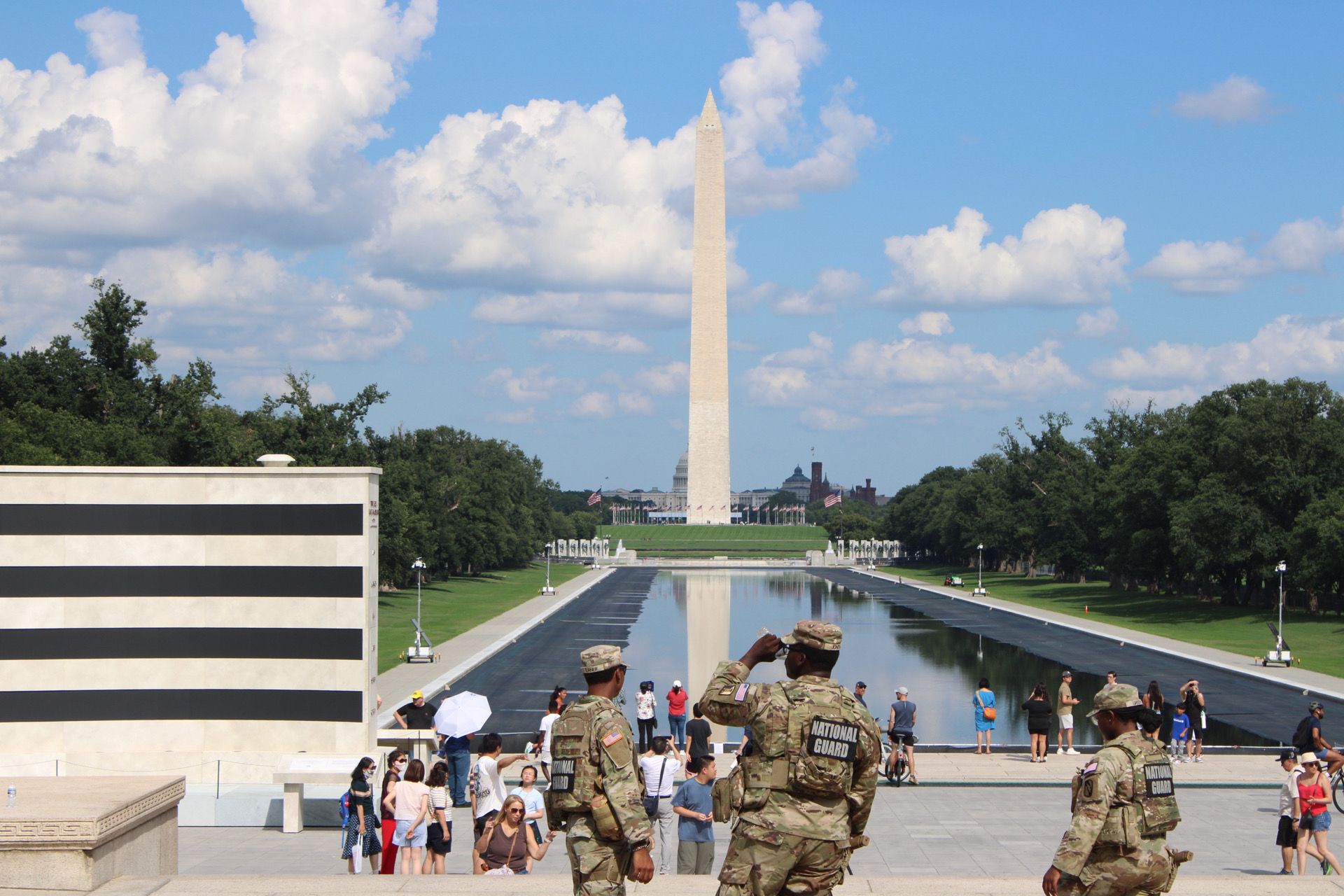

Washington, DC – A year after United States President Donald Trump deployed the National Guard to Washington, DC, opinions are mixed among residents, politicians and experts about the mission’s success.
Thousands of troops were deployed to DC in August 2025 as part of Trump’s Safe and Beautiful Task Force after he declared a crime emergency in the city.
- list 1 of 3National Guard deployment to Washington, DC, will cost US roughly $1.4bn
- list 2 of 3Trump administration to dismiss Reflecting Pool charges against David Hearn
- list 3 of 3America250 vs Freedom 250: What to know about the US’s 250th anniversary
end of list
The arrival of the soldiers triggered immediate opposition from many DC residents, with protests throughout the year. The advocacy group Free DC organised 11 days of demonstrations culminating in a protest outside the White House on Tuesday against what the group calls a “hostile military occupation”.
“I think Trump should go ahead and let them go home,” Ybonne Coles, a 60-year-old restaurant worker who was born and raised in the capital, said on a hot August day in Farragut Square as several soldiers patrolled nearby.
“They ain’t doing nothing but walking,” said Coles. “That money could go towards organisations to help people that really need help.”
The deployment has also faced resistance from legal officials, who have questioned its constitutionality.
On September 4, DC Attorney General Brian Schwalb sued the Trump administration over the deployment, which the lawsuit claimed was an illegal use of military force for law enforcement purposes in violation of the Posse Comitatus Act.
US District Judge Jia Cobb ruled to end the deployment on November 20, but a federal appeals court later granted the administration’s request for a stay on the order as litigation continues.
Advertisement
DC Mayor Muriel Bowser, whose administration Trump blamed for what he described as soaring crime rates, similarly criticised the legality of the deployment.
“We use the Guard to respond to emergencies. We use the Guard for large-scale events. We do not use the Guard to police our local laws,” Bowser said at a DC conference in October.
As the deployment approached its one-year mark, federal officials announced a “summer surge” of National Guard troops in advance of the 250th anniversary celebrations in the capital, requesting an additional 1,500 troops.
‘Peaceful and tranquil’
Not everyone opposes the National Guard’s presence.
Aaron Taslitz, a 30-year-old teacher who also works as a bike courier in DC, said that, though he would prefer that military resources be used on something more urgent than roaming the streets of the capital, he does feel safer with them around.
“For the most part, they’ve kept things peaceful and tranquil here,” he said, as he took a break from his morning bike ride in Dupont Circle.

Trump has often railed against DC, calling it “one of the most unsafe cities anywhere in the world” and claiming that since the Guard was brought in, crime has dropped by 88 percent.
However, the precise impact of the National Guard’s presence on crime in Washington, DC, remains unclear.
A report from the Niskanen Center in May found that the deployment has had no significant impact on violent crime, which has been in consistent decline in the district over the past few years.
Although the report found notable reductions in property crimes, it showed a limited impact of the troop presence on “opportunistic” crimes.
“They’re not trained police officers,” explained Richard Hahn, a co-author of the report. “The best thing a National Guard member can be, in terms of a crime deterrent, is a sentinel.”
Troop patrol zones have also concentrated in “high-traffic” areas, including tourist hubs like the National Mall and Union Station.
“Violent crime really concentrates in specific places in DC,” said Hahn. “And those are places where, by and large, the Guard was not deployed.”

Currently, 4,636 soldiers are deployed to the DC mission, including nearly 700 from the DC National Guard and thousands from various other state guards, according to a Joint Task Force-DC spokesperson. The largest out-of-state contributors are Georgia, South Carolina and Mississippi.
Advertisement
Despite the high number of troops, local news stations in DC have reported a notable absence of troops east of the Anacostia River, where several neighbourhoods post some of the highest violent crime rates in the city.
Commanding General Leland D Blanchard II indicated in a news conference on August 3 that patrol zones would shift in the coming weeks, but declined to provide further details.
‘Unnecessary’ use of force
A Senate investigation and report, authored by Senators Gary Peters and Andy Kim in February, also expressed concerns that the deployment risked harming local trust in law enforcement, politicising the armed forces and reducing troop preparedness.
The report further identified a threat to civilian privacy posed by the Guard’s software tools, including social media monitoring systems Meltwater and Cision, and the Palantir Technologies platform Maven Smart System.
The National Guard has also faced multiple lawsuits since the deployment began last August.
On July 29, the American Civil Liberties Union filed a claim on behalf of retired US Army captain Anna King after members of the Idaho National Guard violently detained her in May for allegedly assaulting an officer two days earlier.
King has denied the allegation and instead believes she was detained for her vocal criticism of the Guard’s presence in the city.
“What you see here is an aggressive use of force that was totally unnecessary and totally disproportionate,” said Michael Perloff, a lawyer representing King, “and this illustrates the broader concerns with the reliance on the National Guard to patrol this district.”

While no official cost has been reported for the first year of the operation, the Senate Committee on Homeland Security reported an annual estimate of $602m.
In July, the Pentagon announced plans to keep the Guard in DC through the end of Trump’s term. According to an estimate obtained by Senator Elizabeth Warren, the deployment will cost an additional $1.4bn from October 2026 to January 2029.
The figure comes on top of an already steep deployment cost so far.
One service member from the Indiana National Guard, who was deployed for a few months as part of the DC mission in November and asked not to be named, expressed mixed feelings about his time patrolling the streets of DC.
“My time there was to help the citizens of DC,” said the soldier, adding that he took pride in providing this service.
“It didn’t matter who they were, what they were doing – I was just there to help in any way that I could,” he said. “I’ve seen people impacted by us in a positive light.”
At other times, though, he said he had his doubts about the mission, noting especially low morale in his unit while they were away from their families during the holiday season.
“There were days when I was like, ‘What are we doing here? We’re not really doing anything.'”
Advertisement
Related News
Hamas denies UN accusations over Gaza aid distribution interference
LIVE: Israeli settlers attack West Bank’s Nablus, shooting leaves six dead

Gambian mothers fear for their daughters as court weighs FGM ban