

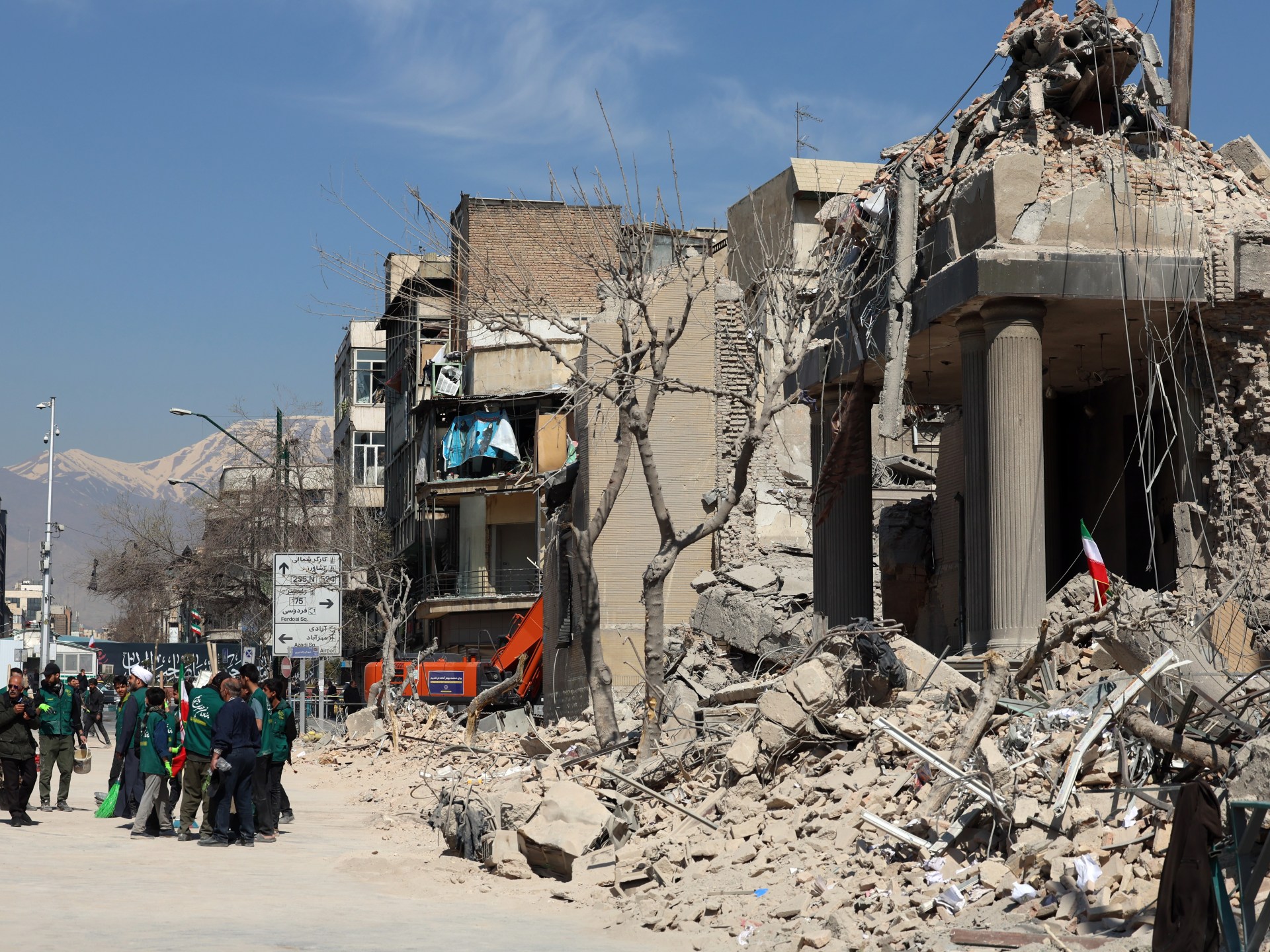

Israel has carried out air strikes targeting security forces across Iran on the fifth day of the US-Israeli assault, as the death toll surpassed 1,000 and Iran launched more counterattacks and warned of the destruction of military and economic infrastructure across the Middle East.
Israeli attacks on Wednesday struck the country’s capital Tehran, the holy city of Qom, western Iran and across Iran’s central Isfahan province, according to the country’s Tasnim news agency. The attacks also damaged residential units, the agency added.
- list 1 of 3Who is Mojtaba Khamenei, a contender for Iran’s leadership amid war?
- list 2 of 3Debris from NATO’s missile interception falls on Turkish soil
- list 3 of 3Iran war: Redrawing the map of the Middle East, Israeli style?
end of list
Israel said it hit buildings belonging to the Basij, a volunteer police paramilitary force of the Islamic Revolutionary Guard Corps (IRGC), as well as targeting buildings associated with Iran’s internal security command.
The death toll since the US-Israeli assault began on Saturday has reached 1,045, Iranian state media reported.
Reporting from Tehran, Al Jazeera’s Mohamed Vall said civilians are bearing the brunt of these attacks, and noted that the country is under fire from every direction.
“There is a continuous, sustained campaign across the country that is not sparing any region, city or area,” he said.
“But we know 300 children and adolescents have been hospitalised … with more than 6,000 [people] wounded,” he added.
Meanwhile, the International Atomic Energy Agency (IAEA) said damage due to attacks was also visible at two buildings near the Isfahan nuclear site, but there has been no damage to facilities containing nuclear material and no risk of radiological release.
As explosions rocked the country, plans to hold a funeral ceremony for the country’s Supreme leader Ayatollah Ali Khamenei were postponed.
Advertisement
Iran’s Tasnim news agency quoted an official citing logistical issues for the delay in the ceremony, which had been due to begin late on Wednesday and last for several days.
Funeral arrangements are ongoing and are expected to draw huge crowds, and, with them, the potential threat of US-Israeli attacks on a gathering of mass mourning. Some 10 million people attended Ayatollah Ruhollah Khomeini’s funeral in 1989.
Khamenei was killed early on Saturday in the first wave of the United States and Israeli assault, which also killed other senior Iranian officials, including the country’s Defence Minister Amir Nasirzadeh.
In response, Tehran has launched retaliatory missile and drone strikes against Israel and US military bases across the Gulf region.
While Israel, the US and Gulf countries have intercepted most of these missiles, some have struck military assets and civilian infrastructure. Debris from those intercepted has also fallen on some civilian areas.
Following the death of Khamenei, senior Iranian officials are working to elect his replacement, with potential candidates ranging from hardliners to reformers.
Ayatollah Ahmad Khatami, a senior Iranian religious leader who is a member of both the powerful Guardian Council and Assembly of Experts, said the country was close to choosing the late Khamenei’s successor.
“The Supreme Leader will be identified at the closest opportunity. We are close to a conclusion; however, the situation in the country is a war situation,” Khatami told state TV.
No official announcement has been made by local authorities, but Israeli and Western media outlets have reported that Mojtaba Khamenei, a hardline Muslim leader, is the frontrunner to become the new supreme leader of the 47-year-old Islamic Republic.
The Israeli defence minister threatened whoever Iran picks to be the country’s next supreme leader.
“Every leader appointed by the Iranian terror regime to continue and lead the plan to destroy Israel, to threaten the United States and the free world and the countries of the region, and to suppress the Iranian people – will be a target for elimination,” Israel Katz wrote on X.
US President Donald Trump, who has suggested the conflict could last several weeks, said on Wednesday that the leadership in Tehran is now in disarray.
“We’re in a very strong position now, and their leadership is just rapidly going. Everybody that seems to want to be a leader, they end up dead,” Trump said.
As the US, Israel and Iran continue trading fire, the United Nations has said that between February 28 and March 1, an estimated 100,000 people fled Tehran due to the conflict.
Advertisement
On Wednesday, Iran’s Foreign Minister Seyad Abbas Araghchi slammed Trump, saying he had “betrayed diplomacy and Americans who elected him”.
“When complex nuclear negotiations are treated like a real estate transaction, and when big lies cloud realities, unrealistic expectations can never be met,” he said in a post on X.
“The outcome? Bombing the negotiation table out of spite.”
Later on Wednesday, the US Senate voted against a resolution to curb President Trump’s ability to wage war on Iraan.
But Trump will face increasing domestic scrutiny as the war on Iran continues, while Israel will likely enjoy more long-term public support, Paul Musgrave, an associate professor of government at Georgetown University in Qatar, told Al Jazeera.
“The political constraints on Donald Trump are greater than they appear,” he added.
Related News
NATO defences destroy missile fired from Iran over Mediterranean: Turkiye
Nepal’s Gen Z threw out old parties. Will it vote for them in key election?
South Africa secures return of 11 men ‘lured’ into Russia-Ukraine war