
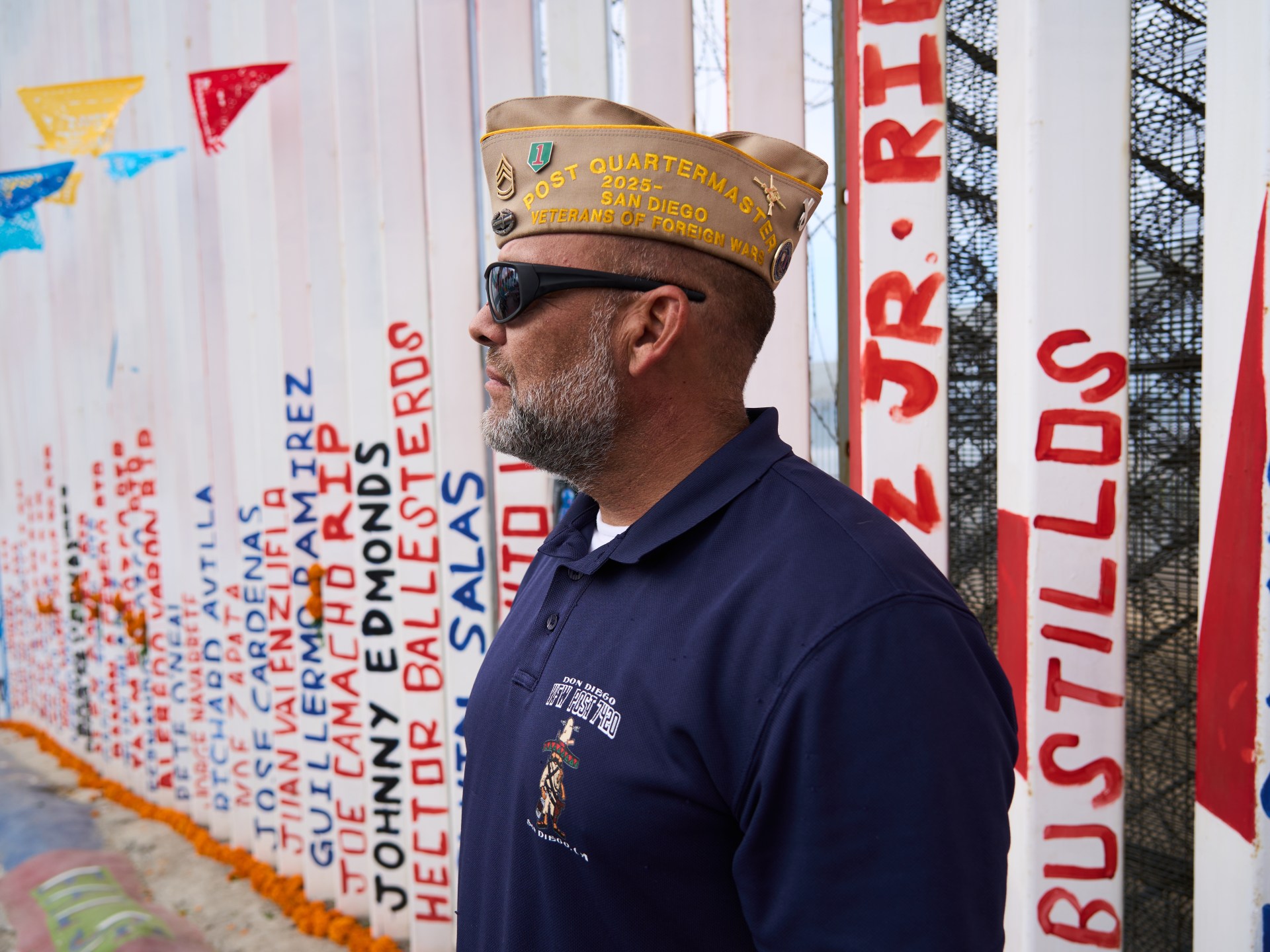

Hernandez has spent most of his life in the US. He was brought across the border by his mother as a baby. He now has three children, all US citizens.
As of 2022, nearly 731,000 military veterans like Hernandez were immigrants. They comprise roughly 4.5 percent of the US's veteran population.
For decades, faced with declining enlistment numbers, the US military has depended on immigrants to serve alongside its US-born citizens. Most have citizenship, too — but an estimated 118,000 immigrant veterans do not. Hernandez is one of them.
Like many other veterans struggling to reintegrate into society after their military service, Hernandez struggled to find his place in the civilian world.
He was jailed on illegal gun charges shortly after returning from his deployment. When he was released a few weeks later, he found he had been evicted from his apartment, and all his possessions, including military memorabilia, had been confiscated.
“I came out with nothing," he told Al Jazeera. With few options left, he became involved in selling drugs, which led him to be in and out of prison on multiple convictions.
Without US citizenship — and especially with convictions on his record — the threat of deportation now hangs over him.
His experience is not an outlier. Roughly a third of veterans are arrested at least once in their lifetimes, and surveys estimate that as many as 181,500 are imprisoned each year.
Many veterans struggle with traumatic brain injuries, post-traumatic stress disorders and substance abuse issues, which can lead them to commit criminal offences.
Hernandez was among those who enlisted after the attacks in the US on September 11, 2001. In the military frenzy afterwards, a recruiter at his California high school convinced him to sign up.
Hernandez was just 18, and the structure, ambition and steady income of military service appealed to him.
“I was trying to make a difference, trying to defend the land that was supposed to be my country — that adopted me,” he said.
Hernandez was deployed when the US invaded Iraq in 2003 and then deployed two more times after that. He worked on the USS Kearsarge LHD-3, an amphibious assault group in the US Navy.
“They said I was going to get to see the world," he said. “I didn't. It was nothing but sea.”
During his first deployment on the ship, he filed his application for citizenship.
The process was supposed to take only about six months. Then-President George W Bush had pledged to expedite naturalisation applications for active-duty service members who served during the wars in Iraq and Afghanistan, in an effort to boost recruitment.
But like other immigrant soldiers at the time, Hernandez’s naturalisation was delayed. The US immigration system has been chronically overwhelmed, and after the September 11 attacks, stricter background checks led to even slower service.
By the time Hernandez was finally called for his citizenship interview in 2006, two years had passed since his return from his final deployment.
He already had a criminal conviction for drug possession. As he was no longer in the military, Hernandez’s expedited naturalisation case was denied.
Related News
EU court rules Hungary’s LGBTQ law violates human rights

China dismisses Vice Minister of Foreign Affairs Sun Weidong
Global hunger report warns of rising malnutrition and famine risks