
January 12, 2010 – 16 Years Later: Haiti, From Earthquake Ruins to Organized Chaos
 12 January 2026
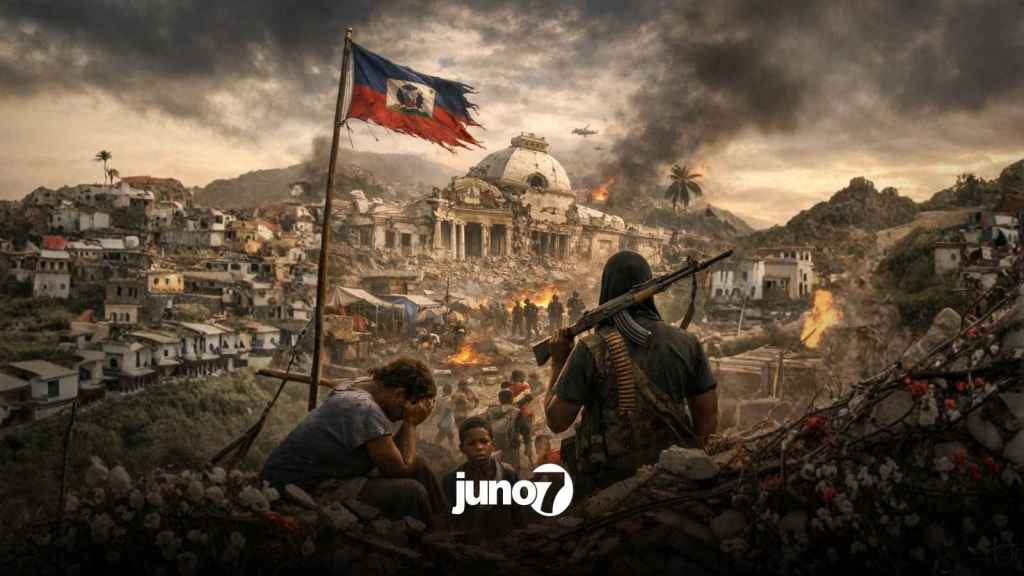

On January 12, 2010, at 4:53 p.m., Haiti collapsed. In less than a minute, a magnitude-7.0 earthquake pulverized Port-au-Prince, Léogâne, and Jacmel, killing more than 250,000 people and injuring 300,000, according to official estimates (1). The very heart of the State crumbled: the National Palace, Parliament, ministries, hospitals, schools. Sixteen years later, the shock has never truly ended. It has transformed. It has taken root. And it is still killing.A text by Nancy Roc on the duty of remembrance and the abandonment of a nation.
The National Palace in Ruins: Symbol of an Abandoned State
At the Champ-de-Mars, the ruins of the National Palace still stand, frozen in time, like a brutal metaphor for Haitian and international failure (2). No construction site, no stone laid, no clearly articulated vision. This symbol of national sovereignty has never been rebuilt, despite the nearly 10 billion dollars pledged by the international community after 2010 (3). Sixteen years later, the Haitian State has still not rebuilt its own heart.
The post-earthquake period had nevertheless sparked an unprecedented global mobilization. NGOs, donors, UN agencies, foreign governments—all promised to “build back better.” But very quickly, Haiti became the so-called “Republic of NGOs,” sidelining its own institutions. Less than 1% of humanitarian aid passed through the Haitian State (4). The result: lack of coordination, incoherent projects, unfinished infrastructure, chronic dependency. Reconstruction was designed without Haiti—and often against it.
On the social front, the scars are immense. Hundreds of thousands of displaced people lived for years in precarious camps. The cholera epidemic introduced by MINUSTAH caused more than 10,000 deaths, deepening the national trauma (5). Even today, nearly half of Haiti’s population faces acute food insecurity (6), while access to water, education, and healthcare remains a luxury for millions of citizens. As for the mental-health consequences affecting an entire people, they have been relegated to silence. Collective trauma, unaccompanied mourning, post-traumatic stress among children and adults alike: no serious public policy has ever been implemented. Sixteen years on, Haiti remains a psychologically wounded country, where invisible suffering has been passed from generation to generation—without care, without recognition, without reparation.
Gangs Deadlier Than the Earthquake: A Prolonged Collapse
But today’s deadliest disaster is no longer natural. It is political, security-related, and criminal.
For several years now, Haiti has been living under gang rule. These armed groups, long instrumentalized by political and economic elites, have taken on autonomy and power (7). In 2024 alone, more than 5,600 people were killed by gang violence, according to the UN High Commissioner for Human Rights (8). Since 2018, the cumulative number of deaths linked to insecurity rivals, over time, that of the 2010 earthquake—turning daily violence into a slow-motion seismic disaster.
What the earthquake destroyed in one minute, the collapse of the State destroys every day. Kidnappings, massacres, gang rapes, forced displacement: more than one million people have fled their neighborhoods (9). Today, over 80% of Port-au-Prince is controlled by armed groups, while the State is absent, dysfunctional, or complicit (10).
This tragedy is not inevitable. It is the result of irresponsible Haitian political choices—corruption, impunity, the instrumentalization of gangs—but also of the blatant failure of the international community, which chose to manage Haiti rather than strengthen it. After 2010, aid often served to maintain a system, not to transform it (11).
Sixteen years after the earthquake, Haiti is not only mourning its dead. It is questioning the world.
What are promises worth without accountability?
What is compassion worth without justice?
What is “international stability” worth when it rests on the abandonment of a people?
The National Palace is still in ruins.
But the country itself is still collapsing.
And this time, it is not the earth that is shaking.
It is conscience.
Nancy Roc, January 12th, 2026
- EM-DAT / UN – The International Disaster Database, CRED, Catholic University of Louvain.
January 12, 2010 earthquake toll: approximately 250,000 dead, 300,000 injured, more than 1.5 million displaced. - Vant Bèf Info,
“Why the National Palace Was Never Rebuilt,” investigation into the abandonment of the Champ-de-Mars. - World Bank / Interim Haiti Recovery Commission (IHRC),
Haiti Earthquake Reconstruction – Financial Tracking Reports, 2011–2015. - Oxfam,
Too Much Aid, Not Enough Accountability: Haiti Six Years After the Earthquake, 2016. - United Nations,
Reports of the Secretary-General on cholera in Haiti (2016–2022). - World Food Programme (WFP),
Haiti – Acute Food Insecurity Analysis 2024–2025. - Jean-Marie Théodat,
Analyses on collusion between gangs and political and economic elites (RFI, Le Nouvelliste, AlterPresse). - UN Office of the High Commissioner for Human Rights (OHCHR),
Human Rights Situation in Haiti – 2024 Report. - OCHA,
Haiti Internal Displacement Overview, 2024–2025. - International Crisis Group,
Haiti’s Gangs: The State Collapse and the Security Vacuum, 2023–2024. - Human Rights Watch,
World Report – Haiti, 2018–2025 editions.
Related News
Venezuela : Donald Trump écarte María Corina Machado et privilégie un dialogue avec le ...

Haïti – Football : la LHF lance les play-offs de la D1 le 11 janvier
Haïti et le Mexique renforcent leur coopération bilatérale
