
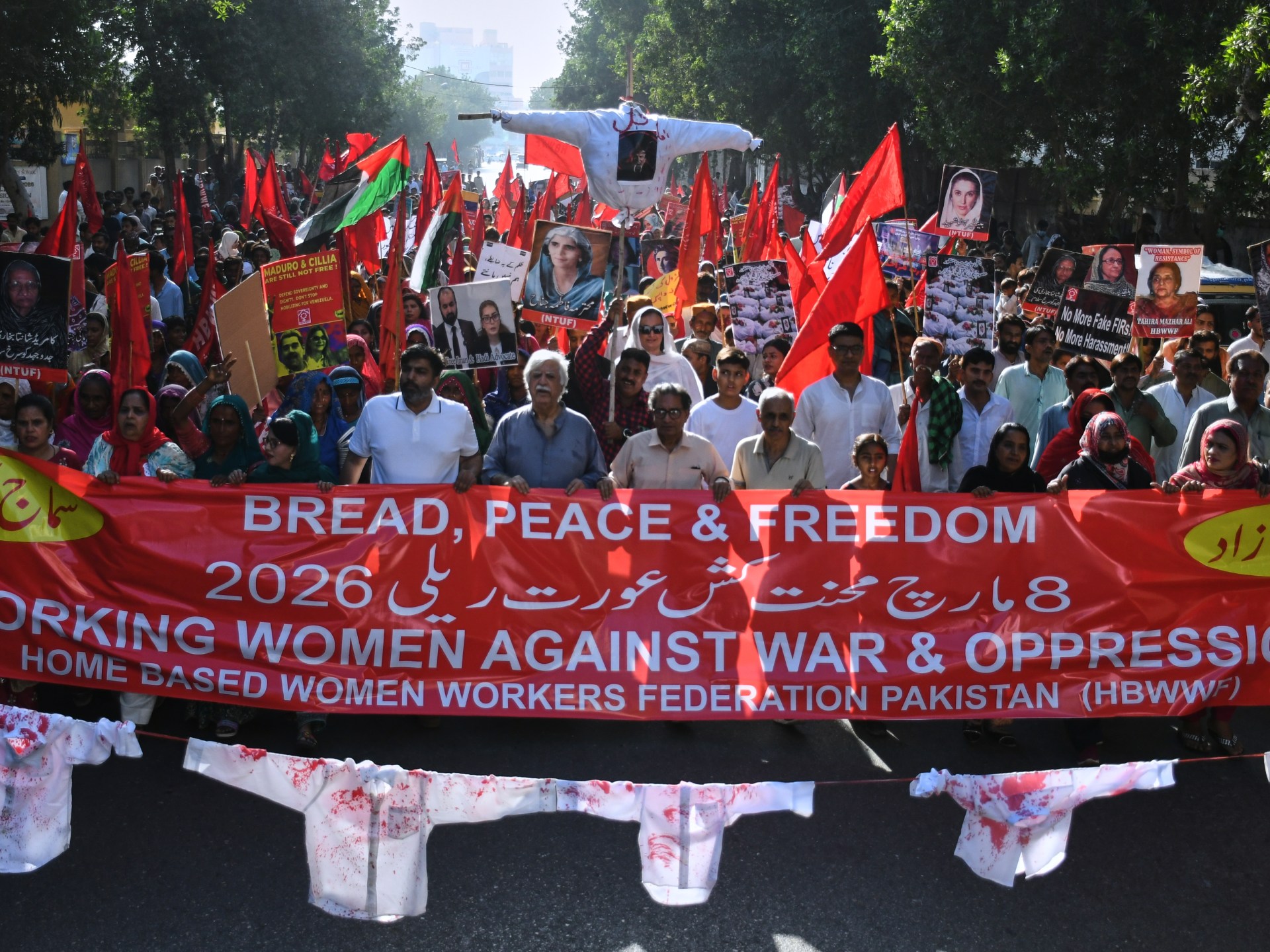

Thousands of demonstrators have taken to the streets around the world to mark International Women’s Day, taking a stand on a number of issues including the US-Israeli war on Iran and gender-based violence.
In Spain, where the government drew the ire of the United States for refusing to allow it to use Spain’s military bases for strikes against Iran, thousands of women took to the streets of major cities to call for an end to the war.
- list 1 of 3Honouring Gaza’s women who refused to let the world look away
- list 2 of 3Iran women’s football team sing anthem, exit Asian Cup amid safety concerns
- list 3 of 3FIFA, AFC urged to protect Iran women footballers after ‘traitors’ threat
end of list
“It is within our power to stop the war, to stop the barbarity, and to win rights,” said Yolanda Diaz, Spain’s second deputy prime minister. “We proclaim ourselves in defence of peace, in defence of the Iranian people, in defence of Iranian women.”
On the first day of the joint US-Israeli war on Iran, strikes on a primary school in the city of Minab killed 165 girls, most between the ages of seven and 12, during class hours – the deadliest single attack on civilians so far.

In France, where more than 150 demonstrations were held, 73-year-old rape survivor Gisele Pelicot led a march calling for an end to sexual violence, telling a crowd in Paris, “We won’t give up”.
Pelicot became a global symbol in the fight against sexual violence after she waived her right to anonymity during the 2024 trial of her ex-husband and dozens of strangers who raped her while she was unconscious.
Advertisement
Across the Atlantic, activists gathered at Zorro Ranch in the US town of Albuquerque, New Mexico, where the late convicted sex offender Jeffrey Epstein is alleged to have sexually abused and trafficked underage girls and young women.
“The years-long cover-up and protection of Jeffrey Epstein’s allies and co-conspirators exposed a culture of impunity that tells survivors their pain is negotiable when powerful men are involved,” said Rachel O’Leary Carmona, executive director of Women’s March.
In New York, protesters gathered outside Trump Tower for a “Believe Survivors” demonstration after this week’s publication of FBI documents by the US Justice Department describing interviews with a woman who alleged President Donald Trump sexually assaulted her when she was a minor.

In Puyo, an Amazonian town in Ecuador, members of various Indigenous groups gathered to raise their voices about the degradation of the environment, and oil and gas expansion. “We want to live in a healthy environment and in harmony with the forest, so we are asking for respect and that public policies for nature are put in place,” said Ruth Penafiel, 59, from the Kichwa community in the northern Amazon.
In Brazil, Sunday’s marches channeled outrage over the alleged gang rape of a 17-year-old girl in Rio de Janeiro’s Copacabana neighbourhood in January. The case gained national attention this week when four suspects handed themselves over to authorities.

In Pakistan’s capital, Islamabad, police briefly detained several women’s rights activists attempting to hold a rally in defiance of a government ban on public gatherings imposed amid a surge in militant violence in the country. Aurat March, a network of women’s rights activists, condemned the crackdown, saying participants had been peacefully exercising their right to protest.
Women’s rights activists shouted slogans during a protest in Istanbul, Turkiye. In China and Russia, vendors sold flowers wrapped in pink. And in Phnom Penh, Cambodia, local workers lifted fists and umbrellas as they celebrated.
International Women’s Day, officially recognised by the United Nations in 1977, marks its 115th anniversary this year.
Related News
Global impunity fuels Israel’s illegal push to annex West Bank: Amnesty

How Putin stays strong in Russia, four years into war in Ukraine
US Senate fails to advance war powers measure to rein Trump’s war with Iran