
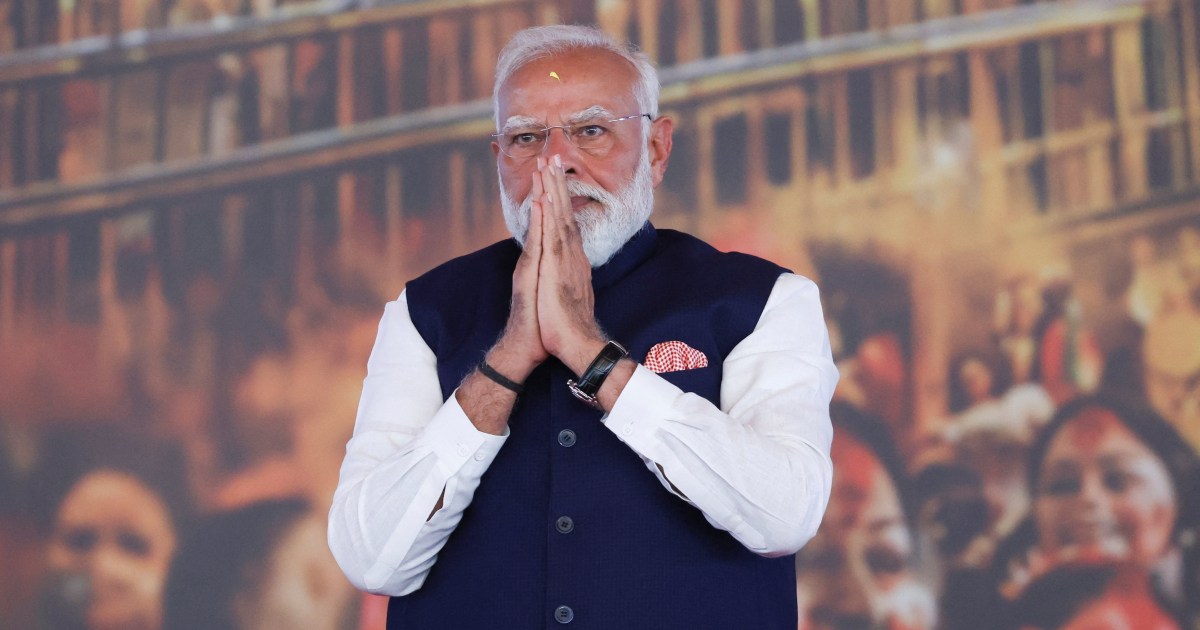

A tricky encounter with a Norwegian journalist has shone a light on the reluctance of Indian Prime Minister Narendra Modi and members of his government to engage directly with the media on uncomfortable issues.
After Helle Lyng Svendsen from Norwegian daily Dagsavisen asked Modi why he wouldn’t take questions from the press, and later the same day asked a senior official of India’s Ministry of External Affairs about India’s human rights record, Modi’s response was to walk away without replying while his minister’s was to try to deflect by talking about unrelated facets of India’s past and present, and then to become visibly angry.
- list 1 of 3‘Hindu order runs India’: Court declares another medieval mosque a temple
- list 2 of 3Tata-ASML deal: How significant is it for India’s semiconductor push?
- list 3 of 3India-Nordic summit: Why is Modi wooing Northern Europe?
end of list
India’s prime minister was in Norway on a two-day visit as part of a tour of northern Europe. On Monday, he met with Prime Minister Jonas Gahr Store and, on Tuesday, Modi took part in the third edition of the India-Nordic Summit, before leaving for Italy, where he is meeting Prime Minister Giorgia Meloni on Wednesday.
Modi has not held a single news conference in India during his 12-year term in office. On his multiple trips abroad, he has only rarely fielded questions – including two in Washington, DC, in 2023.
The incidents in Norway have renewed criticism from media organisations, which point to India’s sliding rankings in press freedom indices.
So why has Modi’s encounter with a Norwegian journalist led to criticism and what do we know about media freedom in India?
Here is what we know.
What happened at the Norwegian news conference?
On Monday, Modi wrote on X that he was addressing a “press meet” with Norway’s Prime Minister Store. However, he did not take any questions from reporters.
Advertisement
When Norwegian journalist Helle Lyng Svendsen from the daily newspaper Dagsavisen, asked: “Prime Minister Modi, why don’t you take some questions from the freest press in the world?” he simply walked out of the conference room. It is not known if the Indian leader heard the question.
Svendsen followed Modi out of the news conference room and asked: “Do you deserve the trust of our … [government]?”
But she did not receive a response to that question, either.
She later took to social media to criticise the Indian prime minister.
“In Norway, when foreign leaders visit, the press usually will get to ask questions. Not many, but a few. That was not the case today with Modi, and will not be tomorrow either,” she wrote on X.
She told Al Jazeera on Tuesday: “We were, of course, expecting him not to answer questions, as that is what the PM does. However, it is our duty to try. I am a privileged journalist as I am reporting from one of the safest countries in the world. If I do not dare to ask questions, who will? I know the situation is alarming for my journalist colleagues in India.”
Store, the Norwegian PM, initially addressed questions from the Norwegian media but not from Indian journalists. However, he later did speak with Indian reporters, too.
Later on Monday, at a separate news conference, Svendsen also questioned the Indian Ministry of External Affairs’s Secretary (West) Sibi George about human rights in India and asked why Norway should trust India amid rights violations there. Human rights organisations have said religious minorities in particular have faced increasing attacks – including physical, psychological and economic persecution – in recent years, with hate crimes and hate speech rising year on year. Critics have pointed to a series of laws on interreligious marriages, religious conversions and a controversial law that discriminates against Muslim asylum seekers from India’s neighbourhood as examples of moves that they say undermine India’s secular constitution.
But George responded by talking about India’s past – how chess was invented in the country, and how the idea of “zero” is believed to have originated in India. He spoke of the millions of vaccines and medicines that India had shared with other Global South nations during the COVID-19 pandemic. “So we are proud of that civilisation. Yoga … originated in India,” he said.
At one point during the news conference, Svendsen interrupted him and asked George why he was not answering her question about human rights.
Advertisement
George, visibly angry by the interruption, responded: “India is a civilisational country.”
He also defended India’s human rights record: “We hear a lot of people asking why this, why that, but let me tell you this. We are one sixth of the total population of the world, but not one sixth of the problems of the world,” George said.
“We have a constitution which guarantees the fundamental rights of the people. We have equal rights for the women of our country, which is very important,” he added.
Svendsen later wrote on X: “Journalism is sometimes confrontational. We seek answers. If any interview subject, especially with power, do not answer what I asked, I will try to interrupt and get a more focused response. That is my job & duty. I want answers and not just talking points.”
The encounter led to a flurry of comments, social media memes and articles, including in the Indian media – some supporting George, but many criticising him, either for dodging Svendsen’s question or for not defending the Indian government well enough.
Why is Modi facing criticism for not taking media questions?
This is not the first time Modi has been criticised for avoiding questions from journalists since he came to power in 2014.
In fact, Modi has not held a single news conference at home during his 12-year term in office. He has been interviewed – usually by media organisations viewed as close to the government. In at least some cases, his office has insisted that media organisations share questions in advance with them. In a few instances, at least, Modi’s office has insisted on only responding to questions in writing – a dynamic that eliminates the possibility of follow-up questions.
In 2023, when Modi attended a joint news conference in Washington, DC, with then-US President Joe Biden, journalist Sabrina Siddiqui of The Wall Street Journal tried to ask him about the treatment of religious minorities and press freedom in India. Modi responded by saying that democracy is “in India’s DNA” and that the country does not discriminate between people irrespective of their caste, creed or religion. But after the question, Siddiqui – a Muslim Pakistani-American journalist – faced intense online harassment and trolling from supporters of Modi’s ruling Bharatiya Janata Party. Some also targeted her religious faith and questioned her roots.
Svendsen told Al Jazeera that she, too, had been subjected to harassment online after the two conferences: “There is a lot of trolling and alarming comments. Some constructive criticism as well, which I welcome.
“Us Norwegians are direct, so I understand that it might be surprising to some. But most of all, so many supporting people appreciating my question to Modi. It is also impactful that my reporting is being discussed in the political sphere in India,” she said.
What has the response to this been?
Besides online social media commentary from journalists and critics, India’s opposition Congress party leader Rahul Gandhi also criticised Modi’s failure to take questions in Norway, writing on social media, “when there is nothing to hide, there is nothing to fear”.
Advertisement
“What happens to India’s image when the world sees a compromised PM panic and run from a few questions?” Gandhi wrote on X on Monday.
Kunal Majumder, Asia Pacific programme coordinator at the Committee to Protect Journalists, told Al Jazeera that it was a matter of concern for press freedom advocates everywhere when leaders of major democracies do not regularly hold open news conferences at which journalists can ask unscripted questions.
“In Prime Minister Narendra Modi’s case, such occasions have been notably rare during his time in office,” he said.
He noted that Modi has himself spoken about being among the most criticised politicians in India, and scrutiny is an inevitable part of public life in any democracy.
“That is precisely what makes open engagement with the press so important: it enables leaders to respond directly to criticism, clarify their positions, and strengthen public trust in democratic institutions. Encouraging that kind of dialogue – rather than stepping away from it – is, in our view, one of the clearest demonstrations of democratic confidence a leader can offer,” Majumder added.
The visibly angry response of George, the Indian diplomat, to Svendsen’s questions about India’s human rights record has also generated a debate online.
Some X users criticised George’s response and called it “whataboutery”.
Rajdeep Sardesai, a veteran Indian journalist, recollected a time when asking tough and inconvenient questions to leaders and diplomats in India during a news conference was the norm.
“Now it’s become so RARE that when a not so tough question is posed by a Norwegian journalist at a press briefing, it becomes a big story and leads to the bona fides and ‘agenda’ of the reporter being questioned!” he wrote on X.
Some journalists, however, criticised Svendsen’s behaviour when she appeared to walk out of the conference for a period of time.
“As a journalist you have every right to ask sharp & critical questions; however, the you have no right to dictate how you are replied to. Walking out is not journalism but shows an angry activism. The MeA (Ministry of External Affairs) won this round,” Swati Chaturvedi, a print and broadcast journalist in India, wrote on X.
Svendsen later replied to this post: “We had been talking for a while and he did not address human rights violation although I asked multiple times to be more specific.”
Majumder said that over the past decade, the space available to journalists in India to ask difficult questions of those in power – particularly on issues relating to human rights, minority rights, and democratic accountability- has visibly narrowed.
“An important point to underline at the outset is that this is not a concern about any single government or political tradition. The pattern we observe cuts across India’s political spectrum, with ruling parties of differing ideologies in different states resorting to similar forms of pressure on independent media,” he said.
How free is the media in India?
India is currently ranked 157th out of 180 countries in the 2026 World Press Freedom Index. Its position has also dropped six places from its 2025 ranking of 151.
Majumder said that there is a growing climate of fear and self-censorship within journalism in India because of the government’s actions towards the media.
“The pressures journalists encounter today extend well beyond direct restrictions on publication. They include sustained online harassment, the initiation of legal proceedings, scrutiny by tax and financial-
enforcement authorities, and the invocation of laws originally framed for very different purposes,” he said.
Advertisement
He said the government frequently makes use of agencies such as the Income Tax Department and the Enforcement Directorate against media organisations perceived as critical and applies statutes with exceptionally broad scope and stringent bail provisions – such as the Unlawful Activities (Prevention) Act, in cases involving journalists, adding that the CPJ views these developments with “serious concern”.
He added that while the number of imprisoned journalists in India has declined to two, CPJ is also increasingly seeing the use of regulatory and legal frameworks to censor and pressure the media in less visible but deeply consequential ways.
“This includes vague takedown orders, content-blocking directives and the blocking of social media accounts belonging to news outlets and prominent journalists,” he said.
On Tuesday, Al Jazeera’s Osama Bin Javaid received a takedown order from X for posting a meme on April 13 linked to India and Pakistan. In an email, X told him police in the Indian state of Uttarakhand had claimed that his post violated Indian law.
“In such an atmosphere, raising questions about human rights or minority protections carries an added layer of political sensitivity, and the professional risks for journalists who do so become correspondingly higher,” Majumder added.
Related News
What is on the table during Lebanon-Israel direct negotiations?
Iran war live: Trump slams Iranian proposal as ceasefire hangs by a thread
Israeli attacks on southern, eastern Lebanon kill at least six people