

Israel’s bitter political divisions are particularly sharp before the country’s October elections. But the furious response to a new documentary about the military’s actions in the genocidal war on Gaza has revealed an issue that much of Israel’s political and media establishment appears united on.
Few of the central allegations in NAZA, made by Israeli filmmakers Yuval Abraham and Rachel Szor, are new. Reports that the Israeli military was relying on artificial intelligence systems to generate targets in Gaza, often killing the inhabitants of entire buildings to kill just one individual identified by the system, were reported in April 2024.
- list 1 of 4Israel weaponises AI for West Bank demolitions
- list 2 of 4Netanyahu threatens to revoke Israeli citizenship of NAZA filmmakers
- list 3 of 4Jerusalem Daily: Israelis protest outside ‘NAZA’ filmmaker’s home
- list 4 of 4Israel would rather not watch NAZA
end of list
Other accusations against Israel, such as committing genocide, deliberately causing a famine, and unlawfully killing children, have also not received much attention in Israel.
In contrast, NAZA has unleashed a litany of abuse from across Israel, and brought the allegations to the centre of Israel’s political debate.
Culture Minister Miki Zohar reacted to the film’s premiere at the Venice Film Festival – where it received a 25-minute standing ovation – by calling for the directors to be stripped of their citizenship and to be investigated by the internal intelligence service for treason.
Army chief Eyal Zamir has dismissed the film as being built on blood libel and ordered a legal probe to hunt down its military and intelligence sources.
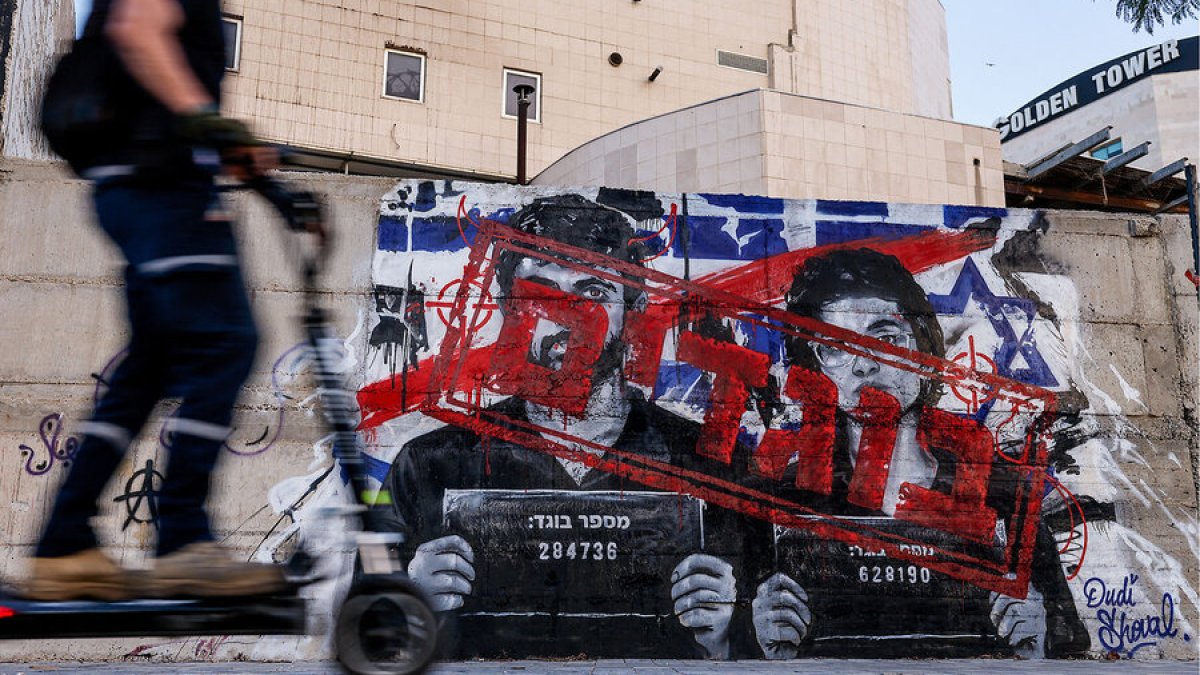
Prime Minister Benjamin Netanyahu also cited the film when advancing legislation to revoke citizenship from anyone deemed to be smearing the country’s soldiers, while in the coastal city of Ashdod, graffiti branding the directors “traitors” has appeared on the walls.
“You can’t really understand the extent of the madness from outside of the country,” Orly Noy, an editor at Local Call, which first carried many of the accusations contained in the film, said. “They’re attacking the friends and families of [the filmmakers] Yuval Abraham and Rachel Szor. They’re talking about revoking their citizenship. They’re asking the Shin Bet to investigate them – for making a film, and it isn’t just the politicians. Journalists, who you might expect to show some kind of solidarity with them, are competing to attack them. It’s scary.”
Advertisement
Denial
In late 2025, the Committee to Protect Journalists reported escalating censorship and harassment in Israel, with Israeli journalists telling the organisation that the media’s approach had become “part of the war effort” and, by extension, significantly shaped Israeli view of their war on Gaza.
In October 2025, a study by the Israeli think tank Molad found that only 3 percent of Channel 12’s coverage of the first six months of the war mentioned Gaza’s humanitarian crisis. Of 206 war-related images and video clips broadcast by the network, Israel’s most-watched channel, only two showed Palestinian civilian casualties.
Nevertheless, before the film’s release, polls found that most Israelis believed the coverage they were receiving of the military’s conduct in Gaza was balanced.

“I guess it was because the mainstream media outlets in Israel did not investigate the conduct of the army during the war in Gaza, and hardly covered the war from the Palestinian point of view,” Anat Saragusti, the Israeli jurist and journalist responsible for press freedom at the Union of Journalists in Israel, said of the shock that had accompanied the release of the film. “[The Israeli media] hardly reported on the human toll and the scale of the humanitarian crisis in Gaza.”
Compounding the gap, Saragusti said, was a deep-seated national narrative: that the war had been imposed on Israel, that Hamas had carried out a massacre on October 7, 2023, and that Hamas’s use of civilians as human shields made mass casualties in Gaza all but unavoidable.
Palestinian deaths, in this telling, were framed less as the product of Israeli conduct than as collateral damage forced on Israel by its enemy’s tactics, she said.
Lynch mobs
“Even journalists that usually support the anti-Netanyahu bloc have criticised the filmmakers,” Israeli political sociologist Daniel Bar-Tal said.
“Israeli Jews deny the genocide,” he continued, “Even all the opposition parties joined the vicious criticism of the filmmakers.”
The language used against the filmmakers has been echoed by some of Netanyahu’s most prominent political rivals.
On Monday, former military chief and one of Netanyahu’s principal rivals Gadi Eisenkot denounced the film for “moral blindness, a detachment from reality, and harm to the State of Israel in a difficult hour”.
Advertisement
Former Prime Minister Naftali Bennett, who is also running in October’s election, called the film a “horrific blood libel against our sons and daughters”.
“Everything gets heightened the closer to the election we get,” Noy said. “But I think only now, for those of us who live here, is the extent of the fascism becoming clear. Journalists, politicians and the media are forming some kind of incitement machine.”
“I’ve had anxieties over where Israel had been going for a long time,” she said, “but right now I’m genuinely worried for my friends and colleagues.”
Related News

Iran war live: Yemen forces reclaim strategic port city Mocha from Houthis
Palestine weekly: Olive harvest opens under assault
Israel lashes out as UK’s Green Party formally defines Zionism as ‘racism’