

She presents herself as the moral embodiment of Venezuelan democracy, brandishes a Nobel Prize as a universal standard-bearer, and proclaims herself the future president of a country still under geopolitical tutelage. Yet by placing her faith in Washington, flattering Donald Trump, and turning democratic symbolism into political currency, María Corina Machado lays bare the deep contradictions of an opposition that confuses the struggle for freedom with the conquest of power. Behind the carefully curated democratic façade, the backstage reveals a far more troubling game.
Analysis by Nancy Roc.
A Nobel Peace Prize Laid on the Altar of Politics
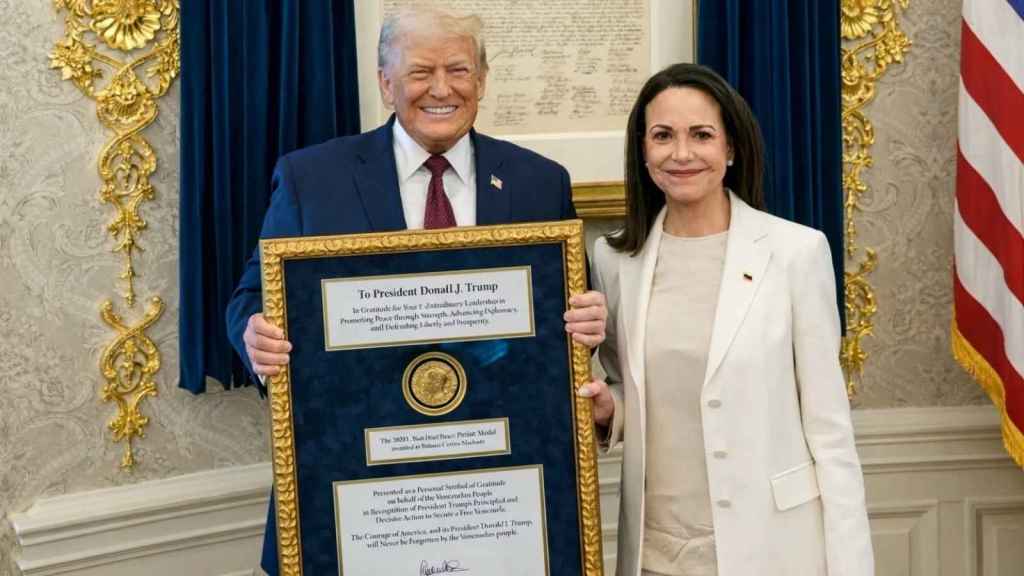
The Venezuelan opposition leader stunned international opinion by claiming she had handed her Nobel Peace Prize medal to Donald Trump. She described the gesture as “moving” and justified it with the supposed gratitude of the Venezuelan people toward the former U.S. president, whom she considers decisive in the country’s “liberation.” Awarded in late 2025 for her fight against the authoritarian regime of Nicolás Maduro, María Corina Machado thus chose to “dedicate” her Nobel to a foreign political figure.
The Nobel Foundation reacted firmly, recalling a fundamental principle:
“Once the Nobel Prize has been announced, it cannot be withdrawn, shared, or transferred to another person. The decision is final and irrevocable.”
Even symbolically, a Nobel Prize is strictly personal. The Nobel Center in Oslo clarified that while the medal may physically change hands, the title of laureate remains intangible.
In Washington, Donald Trump hailed the act as a “wonderful gesture of mutual respect,” posing with Machado and the medal in the Oval Office. The image shocked far beyond Scandinavia. It showed a democratic opponent handing the universal symbol of peace to a populist leader regularly accused of undermining democratic norms.
From Democratic Icon to Trumpist Alignment
How did the woman who claims to be the democratic conscience of Venezuela come to elevate Donald Trump as a providential figure? The alliance blurs ideological lines. In Norway, the discomfort is palpable.
“It is completely different to use the prize to raise funds for a good cause than to hand it to the most powerful man on Earth, someone who constantly undermines democracy,” says political scientist Benedicte Bull, calling Machado’s political use of her Nobel “very sad.”
Criticism has multiplied. “It’s pathetic,” snaps Janne Haaland Matlary. Raymond Johansen calls it an “incredibly shameful” act. In just a few days, María Corina Machado shifted from moral icon to political actor willing to instrumentalize a universal symbol.
Self-Proclaimed President, Disavowed Ally
Alongside the Nobel episode, Machado has proclaimed herself “future president of Venezuela.” Buoyed by her victory in the opposition primaries in 2024, she claims a popular mandate.
“I believe I will be elected president of Venezuela, when the time comes,” she said on Fox News.
That certainty collided with post-Maduro realpolitik. On January 3, 2026, Donald Trump said it would be “very difficult” for Machado to govern the country, arguing that she lacks sufficient support and respect inside Venezuela. Washington opted for what it deemed a more “stable” transition, backing Delcy Rodríguez as interim president in order to preserve the state apparatus and U.S. strategic interests.
The Edmundo González Case: An Election Erased
This marginalization takes on sharper relief when recalling that Edmundo González Urrutia, the opposition’s consensus candidate, was elected president in the 2024 vote, before being forced into exile in Spain under pressure and threats from the chavista regime.
Initially, María Corina Machado acknowledged this victory and called for his restoration to power, asserting that he embodied the democratic legitimacy born of the ballot box.
But as Washington redrew the contours of the transition, Edmundo González’s name faded from Machado’s discourse. The elected but blocked president gave way to a personal presidential claim. The question thus arises: did María Corina Machado turn her back on Edmundo González, or did she sacrifice him on the altar of her own ambitions? By proclaiming herself “future president” while no longer referencing the existing electoral mandate, she blurred the very democratic hierarchy she claims to defend.
An Opposition Trapped by Its Contradictions
This shift in the center of gravity, from an elected president in exile to a personal bid for power, has weakened opposition unity and handed Washington an additional argument to impose a transition without genuine electoral anchoring. Long a hard-line figure, Machado called for international intervention, arguing in 2025 that Venezuela was already “invaded” by Russian and Iranian agents. The 2026 U.S. intervention fulfilled that wish, but it also revealed her strategic isolation.
When Democracy Becomes Inconvenient
Ultimately, the María Corina Machado case poses an unsettling question: what is democracy worth when it no longer serves the ambitions of the moment? By marginalizing Edmundo González, elected yet exiled, the opposition she embodies allowed a dangerous logic to take hold, one in which electoral legitimacy becomes negotiable, reinterpretable, and even expendable.
Venezuela did not only need to be freed from an authoritarian regime. It needed to prove that ballots still matter, even when they yield a politically inconvenient result. By conflating international recognition, American endorsement, and real power, María Corina Machado risks remaining not the architect of a democratic transition, but the symbol of a missed opportunity, namely the chance to defend democracy to the very end, even when it did not bear her name.
Footnotes
- Statements by María Corina Machado on Fox News, January 2026.
- Nobel Foundation, Statutes of the Nobel Foundation, section “Awarding of the Prize.”
- Benedicte Bull, University of Oslo, statements to the Norwegian press, January 2026.
- Janne Haaland Matlary, comments reported by Norwegian media.
- Raymond Johansen, public statement, Oslo.
- Fox News, interview with María Corina Machado, January 2026.
- Statement by Donald Trump to the press, January 3, 2026.
- Results of the 2024 Venezuelan presidential election; exile of Edmundo González Urrutia in Spain (El País, BBC Mundo, France 24).
- Statements by María Corina Machado supporting Edmundo González, 2024 (Reuters, El País).
- Statements by María Corina Machado supporting Edmundo González, 2024 (Reuters, EPaís).
- Analyses of the post-Maduro transition (The Washington Post, Financial Times, Le Monde, January 2026).
Related News

Stressé par la situation migratoire, Kesnel Dorlean quitte les États-Unis pour le Brésil
Affaire BNC et pressions internationales : Smith Augustin face à un risque judiciaire acc...
U-17 féminines : Haïti s’impose 6-1 et prend la tête