

The U.S. military intervention in Venezuela marks a dangerous turning point for both the global and regional balance. In a Caribbean historically committed to peace and international law, reactions have ranged from firm condemnation to diplomatic caution and strategic concern. Faced with the brutal return of the law of the strongest, one voice has stood out with clarity that of Mia Amor Mottley, Prime Minister of Barbados. Yet amid this diplomatic chorus, one absence is striking: Haiti. An overview by Nancy Roc.
The U.S. offensive in Venezuela has sent shockwaves across the Caribbean, reviving old regional traumas linked to unilateral interventions and the gradual erosion of international law. Beyond Washington’s security justifications, a fundamental question emerges: who protects small states when rules no longer apply to the powerful?
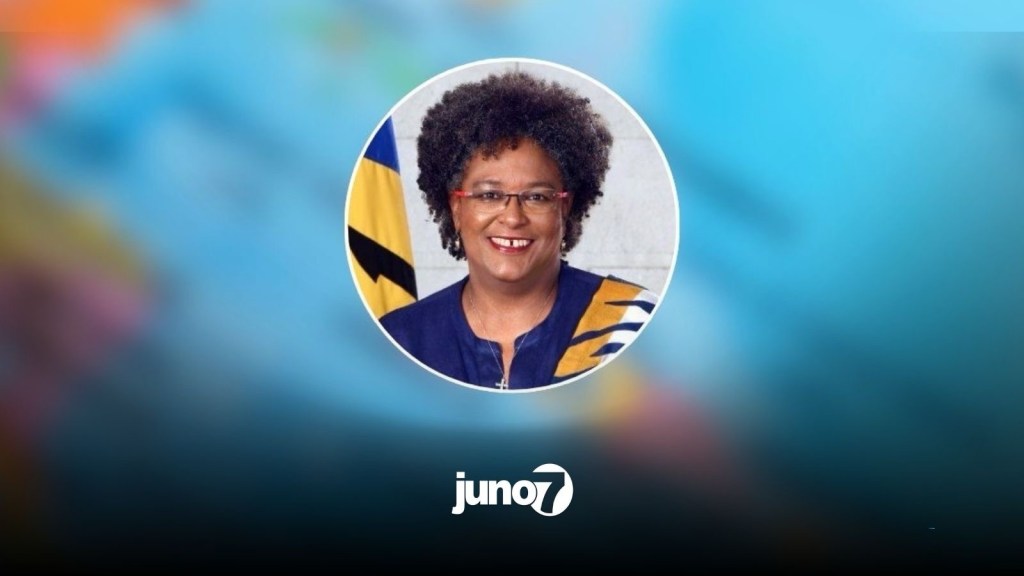
From Bridgetown, Mia Amor Mottley, Prime Minister of Barbados and Chair of CARICOM, delivered one of the most lucid and consequential responses of this crisis.
“We are entering uncharted territory. When power replaces law, no country — small or large — is truly safe.” Mia Mottley, press conference, January 4, 2026
Without explicitly condemning Washington or defending Caracas, the Barbadian leader reframed the debate around the essential issue of international law, reminding the world that for small island states, multilateralism is not a diplomatic luxury but a condition for survival. When it collapses, it is always the most vulnerable nations that pay the price.
CARICOM: Peace as a Red Line
Under her leadership, CARICOM convened emergency consultations, calling for de-escalation, dialogue, and respect for state sovereignty, while reaffirming that the Caribbean must remain a zone of peace. Often criticized for its restraint, this consensus-driven diplomacy now appears as one of the last barriers against the normalization of force.
Cuba: The Memory of Interference
In Havana, the reaction was unequivocal. Cuba condemned the U.S. intervention, denouncing a “flagrant violation of Venezuelan sovereignty” and a dangerous precedent for the international order.
This stance reflects a political memory shaped by decades of interference and sanctions, where unilateral use of force is not a theoretical concern but a lived reality.
Dominican Republic: Stability Above All
The Dominican Republic, a key economic and diplomatic actor in the Spanish-speaking Caribbean, adopted a more measured position. Through its Ministry of Foreign Affairs, Santo Domingo called for restraint, respect for sovereignty, and a swift return to diplomatic dialogue, underscoring the direct risks of instability for the region.
This prudence is driven as much by geopolitics as by concrete realities: migration, trade, tourism, and security are deeply interconnected.
Haiti: Silence as a Symptom
Yet within this regional sequence, one silence remains deafening: Haiti’s.
To date, no official statement has been issued by Haitian authorities, neither condemning the intervention, nor calling for dialogue, nor even reaffirming the country’s historic commitment to state sovereignty.
This muteness reflects the diplomatic erosion of a state consumed by an unprecedented security, humanitarian, and institutional crisis. Once a standard-bearer for the right of peoples to self-determination, Haiti now appears absent from the debates reshaping its regional environment.
Shared Concern, Despite Diverging Positions
From Trinidad and Tobago to Guyana, responses vary but converge around a common fear: the creation of a dangerous precedent for regional stability.
Jamaica, a diplomatic and economic heavyweight in the Anglophone Caribbean, also voiced its concern. In an official statement, Kingston called for respect for international law, immediate de-escalation, and a solution grounded in multilateral dialogue, warning that any major instability in Venezuela would have direct repercussions across the Caribbean.
Without explicitly condemning Washington, Jamaica thus aligns with a strategy of cautious pragmatism, seeking to prevent the conflict’s regional spillover while reaffirming the Caribbean’s historic attachment to sovereignty and non-interference.
The Venezuelan crisis is not merely a diplomatic episode. It is a brutal wake-up call. It exposes the vulnerability of small states in the face of resurgent power politics, the vital importance of international law, and the political cost of silence.
At this pivotal moment, Mia Mottley’s words serve as a moral compass. They remind us that peace cannot be built through force, and that without shared rules, security is little more than an illusion. For the Caribbean, remaining a zone of peace is no longer an abstract principle. It is an existential urgency. As for Haiti, today’s absence of voice raises a painful question: how can it exist tomorrow in a regional order being reshaped without it?
Nancy Roc, January 9th, 2026
Read also : Roc and Truths – Independent Geopolitical Analysis
Footnotes
Miami Herald, “U.S. military action in Venezuela sparks regional concern,” January 6, 2026.
NY Carib News, “Mia Mottley urges restraint and respect for international law,” January 5, 2026.
Caribbean Today, “Barbados PM warns of regional instability after Venezuela crisis,” January 5, 2026.
CARICOM Secretariat, Official communiqué on the situation in Venezuela, January 6, 2026.
Granma, “Cuba condemns U.S. aggression against Venezuela,” January 6, 2026.
Ministry of Foreign Affairs of the Dominican Republic, Official statement, January 6, 2026.
Cross-check of official Haitian government and Ministry of Foreign Affairs statements, as of January 7, 2026.
St. Lucia Times, “Caribbean leaders react to U.S. action in Venezuela,” January 6, 2026.
Jamaica Ministry of Foreign Affairs and Foreign Trade; Jamaica Observer, “Jamaica calls for calm after U.S. action in Venezuela,” January 6, 2026.
Related News

Haïti – Taux de référence BRH : 130,68 gourdes pour 1 dollar américain
PAPJAZZ 2026 : Port-au-Prince retrouve le souffle du jazz international

Culture : FESTISLAMUSIQUE met en lumière le slam, la musique et la danse à Port-au-Prince