

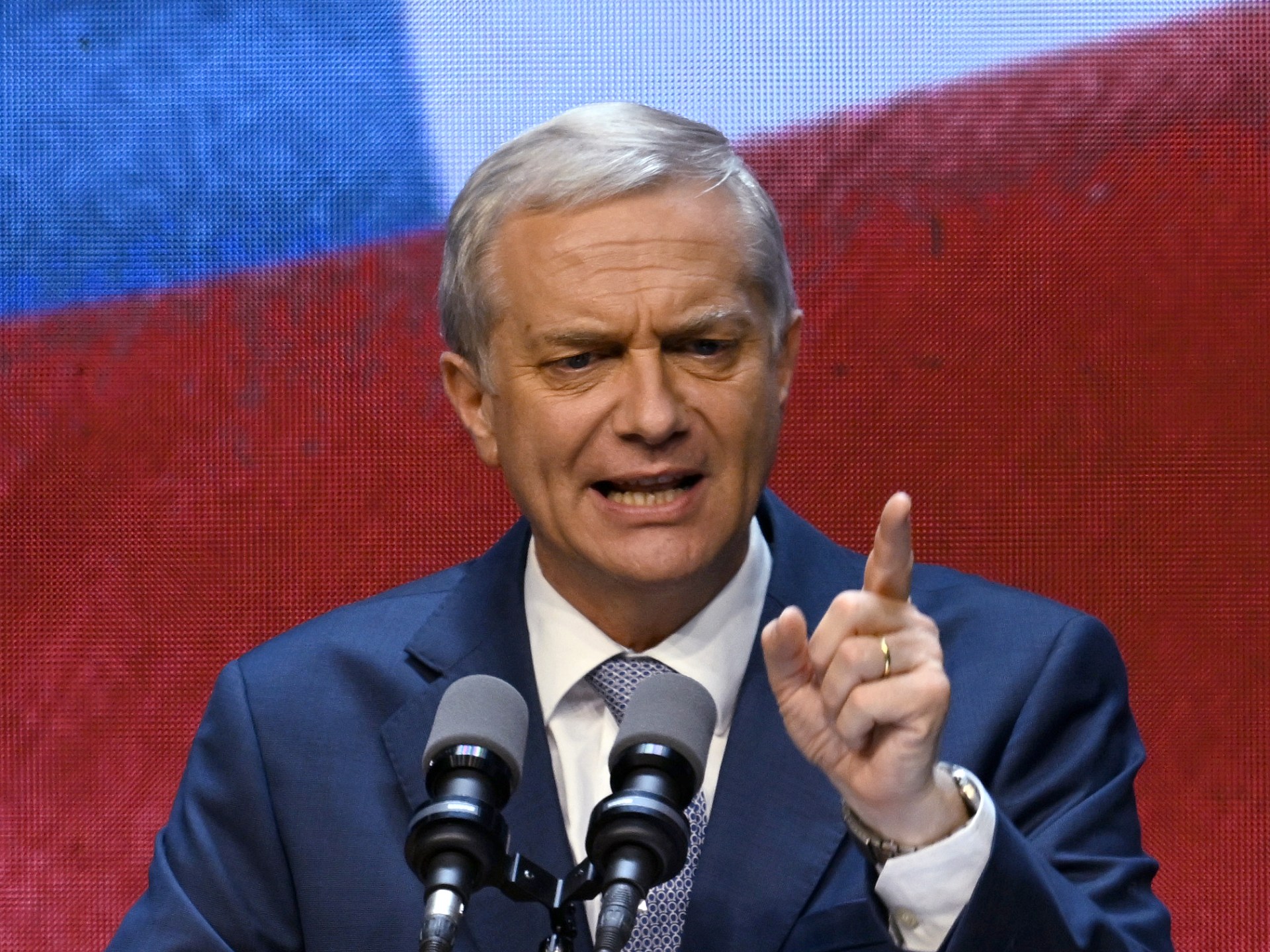

Far-right candidate Jose Antonio Kast of the Republican Party – who claims to be inspired by US President Donald Trump – has won Chile’s presidential run-off election, marking a major shift in the Latin American nation’s political landscape.
Kast, who campaigned on a promise to expel undocumented migrants and crack down on crime, secured 58 percent of the votes against left-wing candidate Jeannette Jara, who won 42 percent, in one of the most polarised elections in recent memory. In the first round, Kast finished second to Jara. But he went on to dominate the December run-off with strong support from across the right wing.
- list 1 of 3Chile votes for new president in communist vs far-right contest
- list 2 of 3Democracy in “question” as far right surges in Chilean election
- list 3 of 3Chile heads to a presidential run-off between leftist, far-right candidates
end of list
“Chile needs order – order in the streets, in the state, in the priorities that have been lost,” the 59-year-old conservative hardliner, who will take office on March 11, 2026, told supporters in his victory speech.
His victory is widely seen outside Chile as part of a broader shift to right-wing politics in Latin America, with conservative leaders winning elections in Ecuador and Bolivia in recent months.
Who is Jose Antonio Kast?
Kast has run for president multiple times. He lost to incumbent President Gabriel Boric in 2021 elections, receiving 44 percent of the vote. In the 2017 elections, he contested as an independent candidate, winning some eight percent of the votes.
After serving for more than 10 years as a congressman from the centre-right Independent Democratic Union (UDI), he stepped down in 2016. Then, in 2019, the 59-year-old leader founded the Republican Party, a more hard-line political entity, appealing to voters disillusioned with mounting insecurity and economic stagnation.
Advertisement
He trained as a lawyer but later entered politics, becoming a councilman for the city of Buin in 1996.
Kast was born in 1966 in Santiago, the capital city, to German immigrants with links to Nazis.
His father was a member of the Nazi Party in Bavaria before emigrating to Chile after World War II. However, the president-elect has claimed his father was a forced Nazi conscript.
Kast’s older brother Miguel was a central bank president and a government minister in the early 1980s during the rule of General Augusto Pinochet. Under his 17-year dictatorship, thousands of people were killed, forcibly disappeared and tortured.
The president-elect is an admirer of Pinochet.
Kast is married to Maria Pia Adriasola, a lawyer, with whom he has nine children.
What does he stand for?
A staunch Catholic, Kast opposes abortion and same-sex marriage. He has stated in the past that he would revoke the country’s limited abortion rights and prohibit the sale of the morning-after pill.
Consuelo Thiers, a lecturer at the University of Edinburgh in the United Kingdom, said Kast will be the most right-wing president since Pinochet.
“Kast is the first president since the end of the dictatorship to have openly supported Pinochet,” she told Al Jazeera.
“[Former President Sebastian] Pinera, the last right-wing president, voted against Pinochet in the 1988 referendum and also embraced some progressive policies, such as the legalisation of same-sex marriage,” she added.
By contrast, Kast supports extremely conservative positions, Thiers said, adding that he was also in favour of granting freedom to individuals convicted of human rights violations committed during Pinochet’s rule.
What are his key policies?
Kast campaigned on public safety, promising to take an iron-fisted approach to crime in Chile – despite the country being one of the safer nations in Latin America.
He has pledged to send the military to high-crime areas, and has promised to build more prisons. An IPSOS poll of Chilean voters in October showed 63 percent of respondents said security was a top issue for them.
The president-elect also takes a tough approach to migration. He has proposed building a police force inspired by the United States’ agency, Immigration and Customs Enforcement (ICE), which has carried out a number of “military-style” raids on migrant communities and workplaces in the US this year in search of undocumented people, many of whom have been detained for deportation.
ICE is responsible for managing the US federal immigration system and has come under increased criticism for its conduct towards immigrants across the country, including those residing there legally.

Similar to US President Donald Trump, Kast has proposed building infrastructure around the country’s northern border to stop people from coming in, and has vowed to deport hundreds of thousands of undocumented migrants.
Advertisement
Analyst Patricio Navia said tackling the issue of undocumented migrants will be his “biggest challenge”.
“According to estimations, there might be up to 400,000 undocumented immigrants,” Navia, a professor at New York University, told Al Jazeera.
“It will be impossible to expel all of them from the country,” he added, but noted that in recent weeks, Kast has “walked back some of his harsher statements”.
“I think he will try to find a balance between his harsh campaign promises and the reality that many of those immigrants contribute to the national economy and are now an integral part of Chilean society,” Navia added.
Kast has also threatened to impose a state of siege in the Araucania region of Chile in order to expel armed Indigenous groups. The measure he is proposing would give the military sweeping powers, including warrantless searches and arrests, and would suspend key civil rights.
How have other countries responded to Kast’s win?
Right-wing allies in the region are celebrating Kast’s victory as part of a broader conservative resurgence across Latin America.
Argentina’s libertarian President Javier Milei was among the first to congratulate him. “Enormous joy at the overwhelming victory of my friend José Antonio Kast,” he posted on X.
Ecuador’s right-wing President Daniel Noboa, meanwhile, said that “a new era is beginning for Chile and for the region”.
US Secretary of State Marco Rubio said his country “looks forward to partnering with his administration to strengthen regional security and revitalise our trade relationship”.
The Foreign Ministry of Spain’s leftist government said it will look to “continue strengthening the friendship between our peoples and the strategic relationship between our two countries”.
What does Kast’s win mean for regional politics?
Chile’s election result is part of a wider regional shift towards conservative and, in some cases, far-right leadership, according to Edinburgh University’s Thiers.
“These leaders have largely come to power on similar promises, particularly the pledge to repair economies in severe distress, as in Argentina, and to improve security in a region where organised crime is rapidly expanding,” she said.
“Many people see in these candidates the promise of a drastic change that could significantly improve their lives,” Thiers added, noting it also reflects a global trend in which incumbents find it “increasingly difficult” to win re-election, “as voters punish them by choosing opposition figures who promise something radically different”.
Meanwhile, academic Navia described recent right-wing victories as “just alternation in power”.
“I would not suggest that the countries are becoming more conservative or illiberal,” he said.
“They were fed up with 20 years of left-wing rule in Bolivia and voted for a moderate right-wing candidate. In Chile, there has been alternation in power every four years since 2009. So, I would not suggest that we are seeing a tectonic shift in preferences.”
Advertisement
Related News
Russia-Ukraine war: List of key events, day 1,388

Judge in Wisconsin, US faces trial over claims of aiding ICE evasion
Lebanese army arrests six after gunmen attack UN peacekeepers in south